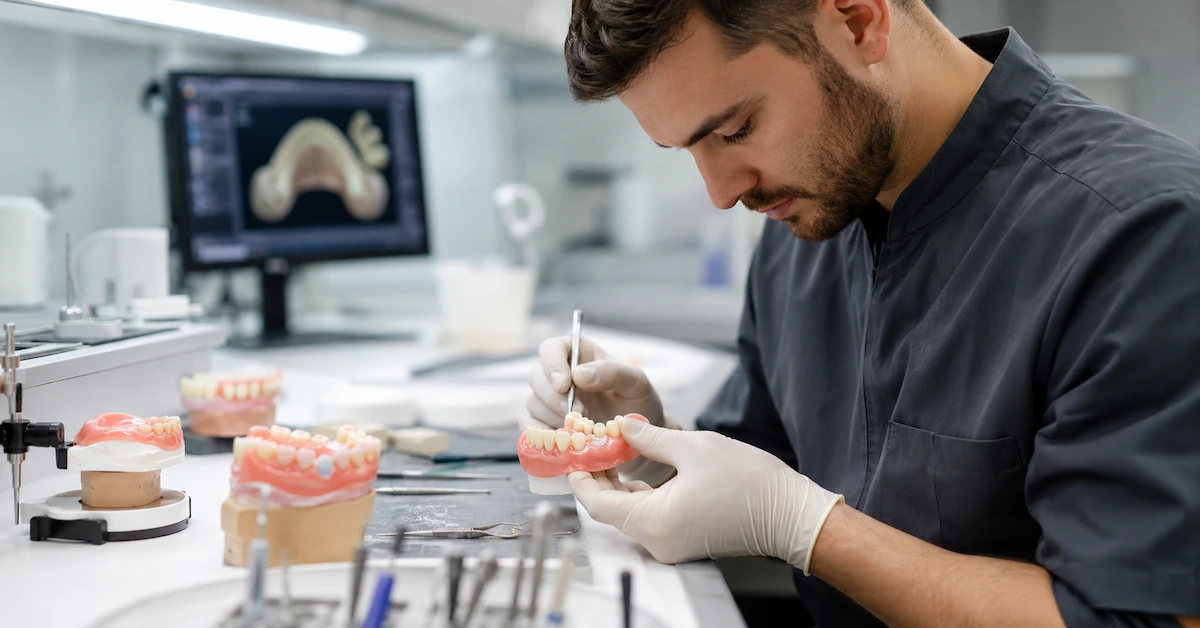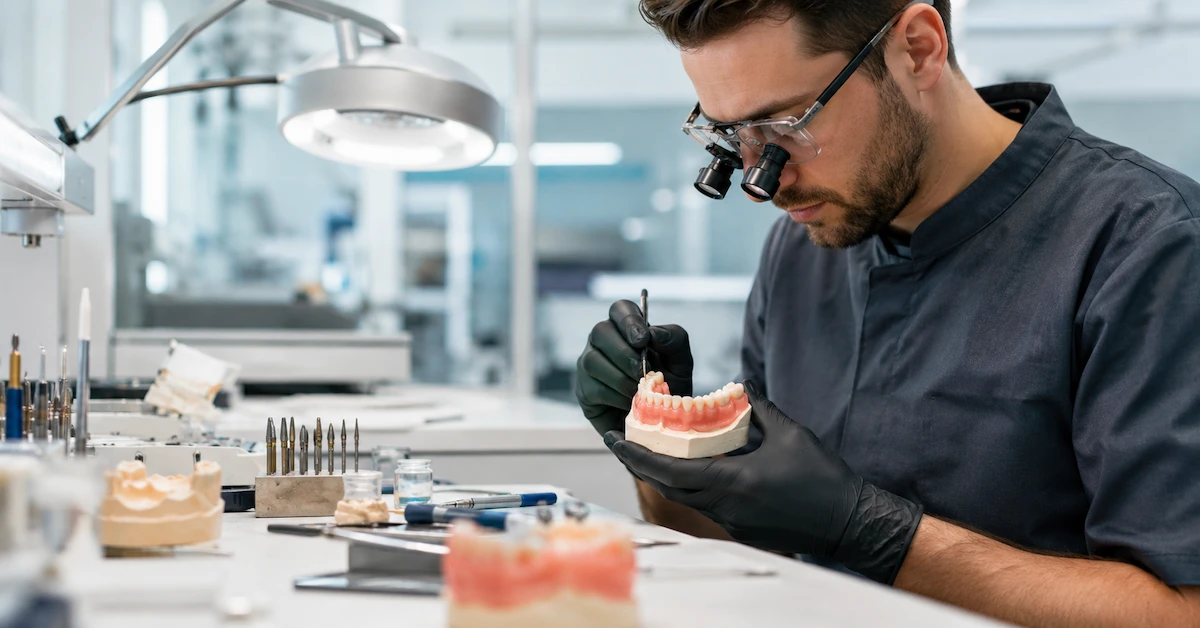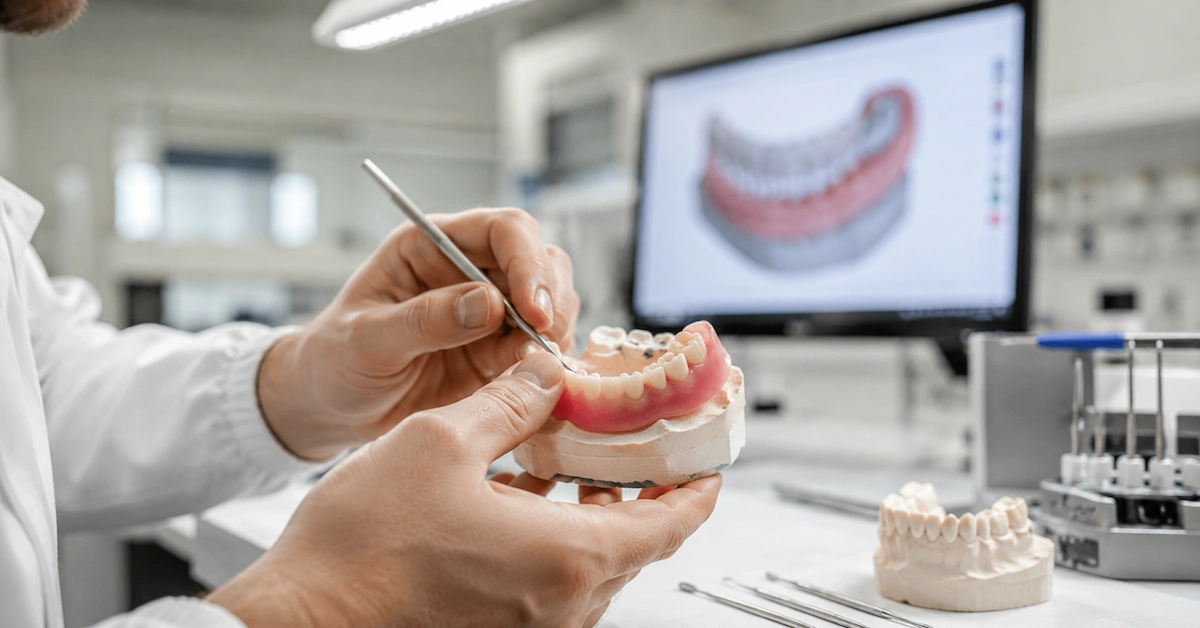

Full dentures are one of the most important removable restorations for patients with complete tooth loss. For dental clinics, these cases are not only about replacing missing teeth. They involve facial support, speech, chewing function, comfort, aesthetics, vertical dimension, and long-term patient adaptation.
A poorly made full denture may cause loose fit, sore spots, unstable occlusion, poor chewing efficiency, or repeated adjustment appointments. A well-made denture can help the patient regain confidence and help the clinic reduce chairside correction time.
That is why choosing the right full denture dental lab matters. A reliable lab should understand complete denture anatomy, denture base adaptation, tooth arrangement, occlusal balance, gum shade, tooth shade, and dentist-lab communication.
At Digilabo Dental Laboratory, full denture and removable restoration cases are supported through digital workflow, removable prosthetic experience, material selection, quality inspection, and international dental lab services for clinics and lab partners.
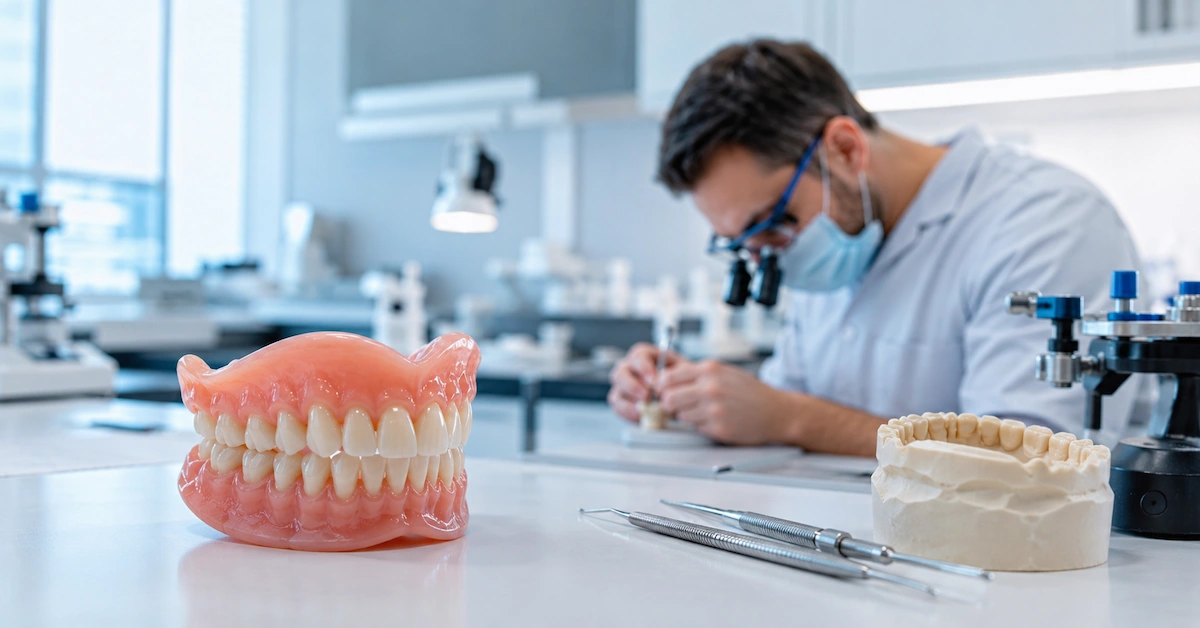
What Is a Full Denture Dental Lab?
A full denture dental lab is a dental laboratory that designs and fabricates complete removable dentures for fully edentulous patients.
A complete denture case usually requires the lab to manage:
- Upper and lower arch records
- Soft tissue support
- Denture base fit
- Vertical dimension
- Bite relationship
- Tooth arrangement
- Tooth shade
- Gum shade
- Smile line
- Occlusal plane
- Polishing and finishing
- Final quality inspection
Compared with partial dentures, full dentures rely more heavily on tissue support, suction, base adaptation, and balanced occlusion. If these details are not handled carefully, the denture may not feel stable during speaking or chewing.
You can explore Digilabo’s removable restoration categories on the Products page, including dentures, frameworks, and combination crowns & partials.
Who Needs Full Denture Lab Services?
Full denture lab services are suitable for clinics and dental professionals who manage complete tooth loss cases.
| Buyer Type | Main Need | Recommended Lab Support |
|---|---|---|
| General dental clinics | Stable complete denture outsourcing | Full upper and lower dentures |
| Prosthodontists | Functional complete removable cases | Balanced occlusion and setup support |
| Geriatric dental clinics | Comfortable dentures for elderly patients | Natural tooth setup and gum contour |
| Dental lab partners | Extra removable production capacity | Full denture outsourcing |
| Clinics with digital scanners | Faster case submission | Digital scan or STL/PLY workflow |
| Implant clinics | Transition from full denture to implant cases | Full denture and hybrid planning support |
For these buyers, the lab should provide more than a basic finished denture. It should support case review, communication, and predictable delivery.
Key Factors in a Successful Full Denture Case
1. Accurate Denture Base Fit
The denture base must adapt well to the patient’s tissue. Poor adaptation can lead to movement, pressure spots, and discomfort.
For clinics, accurate impressions or digital records are essential. For labs, careful base processing and finishing are equally important.
2. Correct Vertical Dimension
Vertical dimension affects facial support, speech, comfort, and occlusion. If it is too high or too low, patients may feel discomfort or look unnatural.
The lab should receive clear clinical records so the tooth setup can follow the dentist’s treatment plan.
3. Natural Tooth Arrangement
A full denture should not look artificial. Tooth size, shape, shade, midline, smile line, and incisal display all affect the final appearance.
For elderly patients, overly bright or perfectly uniform teeth may look unnatural. A good lab understands how to balance aesthetics with patient age and expectations.
4. Balanced Occlusion
Full dentures need stable occlusion to reduce tipping, rocking, and chewing instability. The lab should consider bite records and occlusal plane during setup.
5. Gum Shade and Contour
Gum contour and shade are important for natural appearance. The denture base should not look flat or plastic-like. Proper contouring improves both aesthetics and comfort.
6. Final QC Before Delivery
Before shipping, the lab should check fit, tooth arrangement, occlusion, surface polish, shade consistency, and case details.
Full Denture Lab Workflow
A clear workflow helps clinics reduce remake risk and improve patient satisfaction.
Step 1: Case Submission
The clinic sends complete case information to the lab.
Recommended information includes:
- Upper and lower impressions or digital scans
- Bite registration
- Vertical dimension records
- Tooth shade
- Gum shade
- Tooth mold preference
- Smile line reference
- Midline reference
- Patient photos if needed
- Existing denture reference if available
- Special comfort concerns
- Delivery schedule
Digilabo’s Service and FAQ page explains the lab workflow from upload and prescription to design validation, production, finishing, QC, and shipping.
Step 2: Case Review
Before production, the lab should review whether the records are complete.
Important questions include:
- Is the impression or scan complete?
- Is the bite record stable?
- Is vertical dimension clearly provided?
- Is this an upper denture, lower denture, or full upper/lower case?
- Are tooth and gum shades provided?
- Is there an existing denture to reference?
- Are there patient concerns such as loose fit or sore spots?
This step helps prevent mistakes before fabrication begins.
Step 3: Tooth Setup and Design
The lab arranges artificial teeth based on the dentist’s prescription and patient records.
During setup, the lab should consider:
- Tooth size
- Tooth shape
- Midline
- Smile line
- Occlusal plane
- Lip support
- Facial support
- Phonetics
- Patient age and appearance
- Functional balance
Tooth setup is one of the most important steps in full denture fabrication because it affects both appearance and function.
Step 4: Denture Base Processing
The denture base is processed using suitable material and technique. The lab must control adaptation, base thickness, border areas, surface smoothness, and gum contour.
A comfortable base helps reduce sore spots and improves patient adaptation.
Step 5: Finishing, Polishing, and QC
Final finishing includes polishing the base, checking tooth arrangement, verifying occlusion, smoothing edges, and inspecting the final denture.
A reliable full denture dental lab should not ship the case without checking practical clinical details.
Full Denture vs. Partial Denture Lab Requirements
| Factor | Full Denture | Partial Denture |
| Patient condition | Fully edentulous arch | Some natural teeth remain |
| Main support | Soft tissue and denture base | Teeth and soft tissue |
| Key challenge | Retention, stability, vertical dimension | Framework, clasps, tooth support |
| Lab focus | Tooth setup, base adaptation, occlusion | Retention design and framework fit |
| Aesthetic concern | Facial support and natural smile | Blending with remaining teeth |
| Common buyer | General clinics, prosthodontists, geriatric clinics | General clinics, removable departments |
This difference matters because a lab strong in partial dentures may not automatically be strong in full denture setup. Clinics should choose a lab with specific complete denture experience.
What Clinics Should Check Before Choosing a Full Denture Lab
Clinics should evaluate a dental lab based on practical case outcomes, not only price.
| Evaluation Point | Why It Matters | What Clinics Should Ask |
| Complete denture experience | Full dentures require different design skills | Do you handle full upper and lower denture cases? |
| Tooth setup ability | Affects smile, speech, and function | Can you follow midline, smile line, and tooth mold preferences? |
| Material options | Affects durability and appearance | What denture base and tooth options do you support? |
| Digital workflow | Improves communication and repeatability | Do you accept STL/PLY scans or digital records? |
| QC process | Reduces adjustment risk | Do you check occlusion, polish, and base fit before shipping? |
| Reline or remake support | Helps long-term case management | Can you support reline, repair, or copy denture cases? |
| Delivery support | Helps appointment planning | Do you support international shipping and tracking? |
A strong lab should help clinics save time, reduce chairside remakes, and provide consistent full denture support.
Common Problems in Full Denture Cases
Common full denture problems include:
- Loose upper denture
- Unstable lower denture
- Sore spots
- Poor bite relationship
- Too much or too little facial support
- Unnatural tooth arrangement
- Poor gum shade
- Rough or overextended border
- Speech difficulty
- Frequent adjustment appointments
A professional full denture lab helps reduce these risks through complete case review, accurate tooth setup, careful base finishing, and QC before delivery.
How Digilabo Supports Full Denture Lab Cases
Digilabo supports global clinics with full denture and removable restoration services.
For full denture cases, Digilabo can support:
- Full upper dentures
- Full lower dentures
- Complete upper and lower denture cases
- Acrylic dentures
- Removable restorations
- Gum shade matching
- Tooth arrangement
- Occlusion checking
- Denture finishing and polishing
- Digital case submission
- QC inspection
- International shipping
For clinics that also need partial dentures, flexible dentures, frameworks, combination crowns and partials, veneers, crowns, or implant restorations, Digilabo provides broader dental lab support beyond full dentures.
You can learn more about the company’s production capacity and technical team on the About Us page, or read more removable restoration topics on the Digilabo Blog.
Full Denture Case Submission Checklist
Before sending a full denture case, clinics can prepare this checklist.
| Case Detail | Why It Matters |
| Upper and lower records | Helps the lab understand arch relationship |
| Bite registration | Supports occlusal accuracy |
| Vertical dimension | Affects comfort and facial support |
| Tooth shade | Matches patient expectation |
| Gum shade | Improves natural appearance |
| Tooth mold preference | Helps match age and smile style |
| Midline reference | Supports natural tooth setup |
| Smile line reference | Improves anterior aesthetics |
| Existing denture reference | Useful for remake or copy cases |
| Delivery schedule | Helps plan patient appointments |
Complete case information helps the lab fabricate a more predictable complete denture and reduces adjustment time for the clinic.
FAQ About Full Denture Dental Lab
1. What does a full denture dental lab do?
A full denture dental lab designs and fabricates complete removable dentures for fully edentulous patients. The process may include tooth setup, denture base processing, occlusion checking, finishing, polishing, and QC.
2. What should clinics send for full denture fabrication?
Clinics should send impressions or digital scans, bite records, vertical dimension details, tooth shade, gum shade, tooth mold preference, patient photos if needed, and delivery requirements.
3. What is the difference between a full denture and a partial denture?
A full denture replaces all teeth in an arch, while a partial denture replaces missing teeth when some natural teeth remain.
4. Why is vertical dimension important in full dentures?
Vertical dimension affects facial support, speech, comfort, and occlusion. Incorrect vertical dimension can cause discomfort or an unnatural appearance.
5. Can full dentures be made from digital scans?
Yes. Depending on the case and clinical records, full denture cases can be supported through digital scans, STL/PLY files, or digital case submission.
6. How can clinics reduce full denture adjustment time?
Clinics can reduce adjustment time by sending accurate impressions or scans, stable bite records, vertical dimension information, shade selection, and clear patient expectations.
7. Does Digilabo support full denture cases?
Yes. Digilabo supports full denture cases, removable restorations, digital workflow, tooth arrangement, QC inspection, and international dental lab services.
8. Where can clinics learn more about Digilabo’s denture products?
Clinics can visit Digilabo Dental Laboratory, explore the Products page, or review the Service and FAQ page.
Conclusion
A reliable full denture dental lab helps clinics deliver complete removable restorations with better fit, comfort, occlusion, aesthetics, and patient satisfaction.
For dental clinics, full denture success depends on accurate records, careful tooth setup, proper vertical dimension, denture base adaptation, finishing, and quality control.
Digilabo supports global clinics with full denture fabrication, removable restorations, digital case workflow, QC inspection, and international delivery. If your clinic needs a dependable full denture lab partner, Digilabo can help you manage complete denture cases with a clearer and more efficient workflow.