
When a bridge collapse is caused by structural imbalance
In the field of restorative dentistry, dental bridges are far more complex than single-crown restorations. Problems with single-crown restorations typically involve marginal fit or occlusal relationships, while bridge failures are more commonly caused by structural imbalances, material limitations, or uneven stress distribution across multiple components.
Common clinical problems include connector breakage, stress concentration in abutment teeth, and instability under long-term occlusal loads. These problems do not always manifest at delivery but rather gradually appear over time.
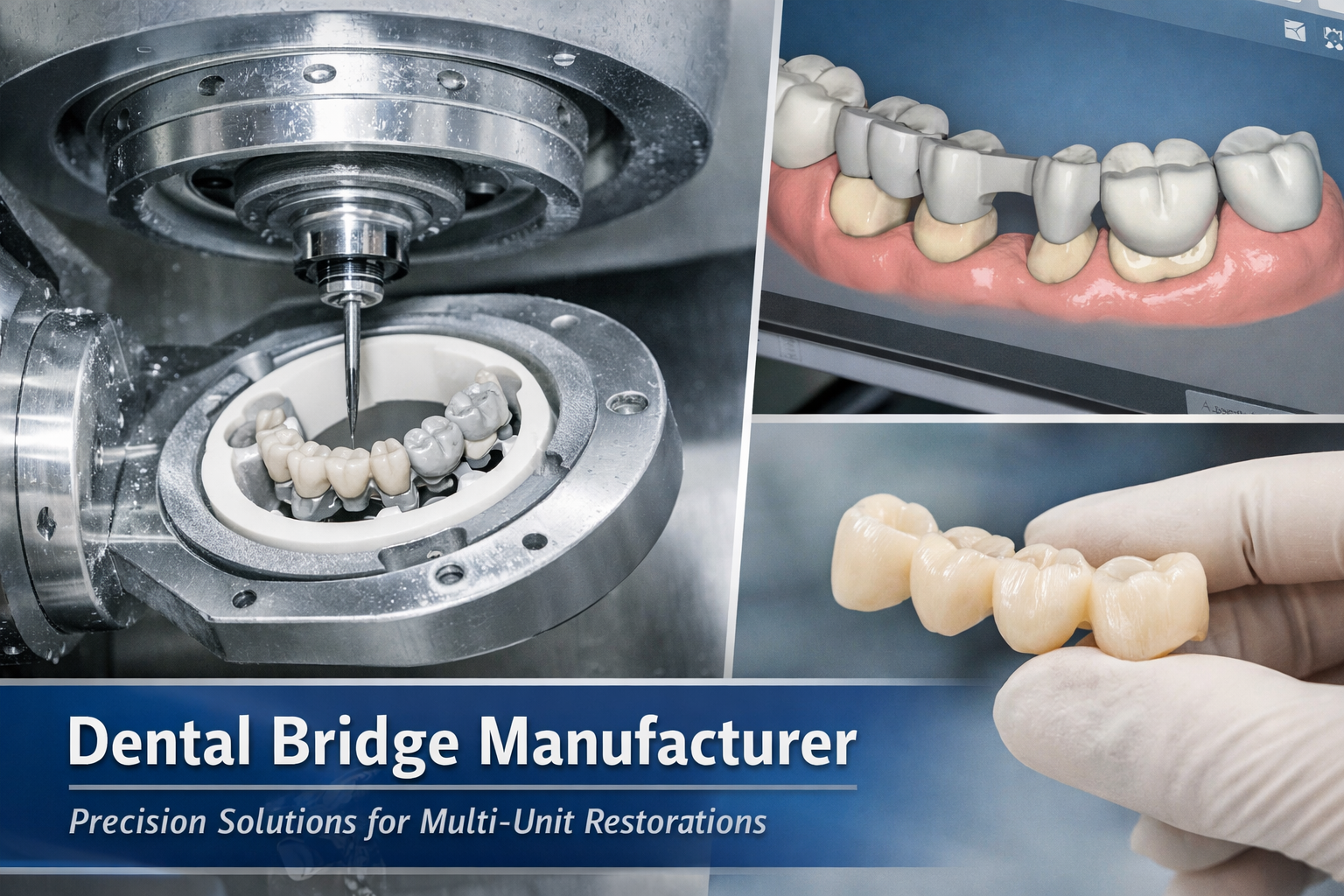
Professional dental bridge manufacturers focus on controlling these variables through design standardization, material selection, and manufacturing precision. At Digilaw, the fabrication of a dental bridge is viewed as a structural system, rather than a series of interconnected crowns, thus ensuring proper control over load distribution and long-span stability.
What qualifications should a reliable dental bridge manufacturer possess?
Manufacturing dental bridges requires more than just basic CAD design skills; it also requires an understanding of the performance of multiple units under functional loads.
A qualified dental bridge manufacturer should provide:
- Multi-unit CAD design with connector optimization capabilities
- Abutment tooth load distribution analysis
- Controlled material processing for long-span restoration
- Consistent milling precision in each unit
- Quality inspection focuses on structural integrity
Unlike individual restorations, dental bridges must function as a single structural unit. Even minor deviations can lead to long-term complications.
Materials and structural design in bridge construction
The choice of materials plays a crucial role in the performance of the bridge structure, especially for multi-unit repairs.
In Dijrabo, commonly used materials include:
- Integral zirconium oxide for high-strength bridge structures
- Layered Zirconia for Aesthetic Anterior Bridges
- PFM for traditional long-span applications
- Titanium support frame for planting bridges
Comparison of bridge material properties
| Material | Strength range | Best application | Structural stability |
|---|---|---|---|
| Monolithic Zirconia | 1000–1200 MPa | Rear axle | Very high |
| Layered Zirconia | 700–900 MPa | Beautiful bridges | high |
| pelvic floor muscles | 700–900 MPa | Long-span bridges | stable |
| Titanium Frame | >900 MPa | Planting bridge | Excellent |
In addition to material selection, structural design is also crucial:
- The thickness of the connector directly affects its fracture resistance.
- Span length affects stress distribution
- Poor design can increase the risk of failure by 20-30%.
Reliable manufacturers incorporate these factors into the design of each bridge.
Why clinics choose professional dental bridge manufacturers
Many dental labs can fabricate bridges, but very few can guarantee consistent quality across all cases.
Clinics typically turn to professional dental bridge manufacturers in the following situations:
- Fracture in multi-unit restorations
- Inconsistent compatibility between bridging units
- Repeatedly adjust the bite
- Long-term performance issues
A partner focused on manufacturing can provide:
- Standardized production procedures
- Consistent results were obtained in multiple cases.
- Reduced connector strength variability
- Improve the predictability of long-span restoration
This consistency is crucial for clinics that handle complex restorative cases.
Bridge body manufacturing and crown production: key differences
| factor | Crown Production Company | Bridge manufacturing |
|---|---|---|
| structure | single unit | Multi-unit system |
| Load distribution | Localization | distributed |
| Design complexity | easing | high |
| Failure risk | reduce | Poor design can result in higher prices. |
| Production Sensitivity | medium | high |
Bridge construction requires higher levels of structural control and precision.
Case Study: Improving Bridge Stability in Multi-Unit Repair Projects
A dental clinic that uses multi-unit zirconia bridges has repeatedly encountered connector breakage issues in posterior tooth cases.
The crown itself was very stable, but the bridge structure failed under load.
After collaborating with Digilabo:
- The connector design was optimized for thickness and geometry.
- Adjusting the bite through digital means can reduce stress concentration.
- Integral zirconia is used to improve strength.
Within a few months:
- Bridge fracture cases have decreased significantly.
- The remake rate has decreased by more than 40%.
- The long-term stability of many patients has improved.
Improvements come from structural redesign and controlled manufacturing , not just material changes.
How dental bridge manufacturers support long-term clinical outcomes
Aortic repairs must maintain their performance over a long period of time under repeated stress.
Professional dental bridge manufacturers ensure long-term effectiveness through the following methods:
- Optimize connector strength
- Ensure consistency in the marginal fit of each unit.
- Balanced bite force distribution
- Maintaining material integrity for a long time
Because bridges are not just repair projects; they are also load-bearing systems .
Q&A
Q: What do dental bridge manufacturers do?
A: Dental bridge manufacturers produce multi-unit restorations designed to replace missing teeth, ensuring structural stability and functional performance.
Q: Why are dental bridges more complex than dental crowns?
A: Bridges consist of multiple interconnected units and require careful design to manage load distribution and prevent structural failure.
Q: What is the best material for making dental bridges?
A: Zirconia is widely used due to its high strength and durability, and is especially suitable for posterior bridges and long-span bridges.
Choose Digilabo as your dental bridge manufacturer
Digilabo is a digitally-driven dental bridge manufacturer that focuses on the structural design, material control, and consistent manufacturing processes of multi-unit restorations.
If you would like to learn more about our production capacity, please visit:
https://www.aspendentallabs.com/about-us
Or click here to learn more about our complete bridge and repair solutions:
https://www.aspendentallabs.com/products
A reliable dental bridge manufacturer does more than just connect crowns.
It ensures that the entire structure functions properly as a system.