
Who This Guide Is For
This guide is intended for dentists prescribing veneers or anterior crowns, clinics developing a repeatable aesthetic workflow, and dental laboratories considering external fabrication support. A cosmetic dental restoration lab should be evaluated against the cases you actually submit, rather than a general claim of “premium quality.” A single anterior restoration, a multi-unit smile case, and a laboratory-to-laboratory order may require different communication arrangements. This is a procurement and case-coordination guide, not a direct-to-patient purchasing guide. Diagnosis, preparation, clinical suitability, and final acceptance remain matters for the treating dental professional.
Define the Aesthetic Task Before Comparing Laboratories
Start the inquiry by stating what the restoration needs to achieve within the clinician’s plan. For a single anterior unit, specify what should match the adjacent teeth and which existing features should remain unchanged. For multiple veneers, identify the approved tooth proportions, incisal edge arrangement, and overall aesthetic reference. For replacement restorations, describe what the clinician and patient want to retain or change instead of writing only “improve appearance.” Our aesthetic restoration services include E.max veneers, layered zirconia, and full-anatomy crowns. That range provides a starting point for discussion; the specific material and construction still need case-level confirmation.

Build a Case Specification Before Asking for a Final Quote
Use the following as a pre-submission checklist, adapting it to the prescribed restoration. It is a case-information template, not a universal clinical specification. The goal is to identify unanswered questions before a cosmetic dental restoration lab commits to design, pricing, or a production schedule. Our veneer case submission guide explains the role of scans, prescriptions, photographs, shade information, and design notes. Keep these records together rather than distributing conflicting instructions across separate messages.
| Case Information | What to Specify or Request | Decision It Supports |
|---|---|---|
| Case identity and scope | Case reference, tooth numbers, restoration type, and unit count | Establishes exactly what is being ordered |
| Scan and bite records | Relevant upper and lower scans, bite record, and clearly identified file versions | Defines the records available for design |
| Preparation information | Visible margins and clinician-provided notes about the preparation | Identifies questions requiring clinical clarification |
| Shade references | Target shade system, shade-tab photographs, and prepared-tooth shade where relevant | Documents the intended color and starting conditions |
| Aesthetic instructions | Smile photographs, desired contours, incisal features, and changes to avoid | Converts broad preferences into reviewable instructions |
| Material specification | Requested material series or a request for discussion before selection | Prevents an unspecified material choice |
| Design approval | Named reviewer, approved version, and outstanding questions | Identifies who can authorize production |
| Delivery requirements | Requested clinic arrival date, destination, and any planned review stage | Separates clinical scheduling from laboratory production |
Compare Restoration Options Without Treating Them as Interchangeable
A material name alone is not a complete specification. Ask the laboratory to identify the proposed material series, construction, and finishing approach, then have the treating clinician confirm suitability. Our restoration product range includes veneers and zirconia restorations, while our laboratory profile also lists E.max crowns. The comparison below is a purchasing discussion framework, not a ranking of clinical superiority. Diagnostic wax-ups are included as planning deliverables, not as final restorative materials; their role is to support discussion of shape and proportions before definitive fabrication.
| Option for Discussion | What the Quotation Should Identify | Aesthetic Questions to Resolve | Approval Boundary |
|---|---|---|---|
| Lithium disilicate veneer or crown | Exact material series and proposed fabrication route | Intended shade, translucency, and individual characterization | Clinician confirms the preparation and material choice |
| Layered zirconia restoration | Zirconia structure and proposed veneering ceramic | Layering, contour, texture, and shade distribution | Confirm the construction before approving production |
| Full-contour zirconia crown | Material grade, shade option, and finishing approach | Contour and surface characterization against the aesthetic brief | Do not assume all zirconia options have identical properties |
| Diagnostic wax-up or design preview | Digital or physical deliverable and included revisions | Tooth proportions, length, arrangement, and requested changes | Planning approval is not approval of final ceramic color |
Make Shade Instructions Specific to Each Tooth
Dental lab shade matching involves more than choosing a single code. Our E.max veneer guidance identifies shade photographs, lighting conditions, prepared-tooth color, and characterization as relevant communication inputs. Use that information to write a more precise brief: identify the target shade reference, areas where color differs, desired incisal translucency, and the surface characteristics the clinician wants reproduced. Where the underlying prepared tooth is relevant, document it rather than asking the technician to infer it. A cosmetic dental restoration lab should be asked to flag missing references before proceeding. For example, “follow the approved reference photographs; retain the specified incisal features; contact the clinician before changing opacity” creates clearer review points than “make it natural.” This is a suggested communication format, not a promise of an exact shade match under every viewing condition.
Separate Shape Approval from Final Appearance Approval
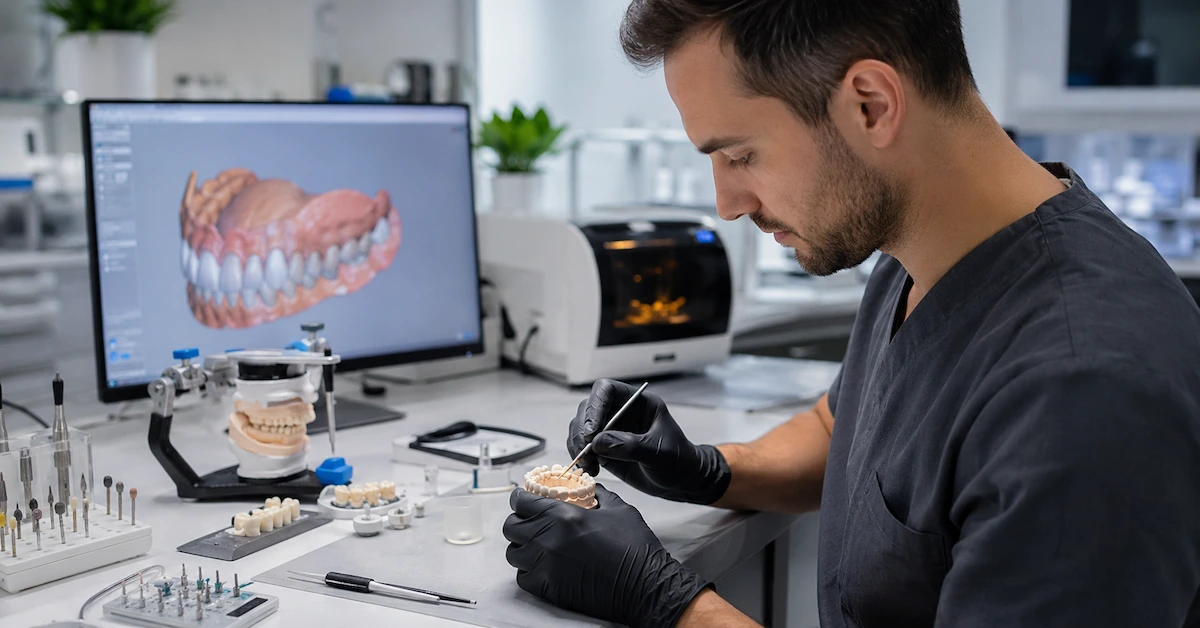
Our service workflow describes case upload, prescription review, CAD design, and a three-dimensional preview for approval before fabrication. Build on that sequence by stating exactly what each approval covers. A useful record might distinguish tooth form, prescribed material, shade instructions, and permission to manufacture. Consider a hypothetical six-unit veneer case: the clinician approves tooth length and arrangement but requests a different overall brightness. Recording “shape approved; shade instructions pending” is clearer than a general “approved” message. Ask the cosmetic dental restoration lab to acknowledge the unresolved item and issue a revised confirmation before production. Keep the approved version, date, and responsible reviewer together. A design preview should not be treated as evidence that every aspect of the finished ceramic has already been accepted.
Ask How the Approved Design Will Be Fabricated and Checked
Our veneer fabrication guide describes case evaluation, CAD design, ceramic processing, finishing, and checks before shipment. When discussing an order, ask which steps apply to the selected material and how revisions will reach the technician responsible for finishing. Request clarification of the proposed shade characterization, surface texture, and final finishing work rather than assuming “CAD/CAM” describes the entire process. For quality review, ask which records can be supplied for the actual case: material identification, checks against the prescription, review of contacts and occlusion against the available records, margin assessment, and inspection of the finished surface. Photographs can support communication, but they should not be presented as proof of every dimensional or clinical requirement.
Evaluate Quality Evidence and Documentation at Case Level
When assessing a cosmetic dental restoration lab, distinguish company-level information from evidence about the restoration you are ordering. Ask which material records, inspection records, and other documentation are available, and which are relevant to your procurement requirements. Where certification is cited, request the actual document and check its named organization, scope, and validity rather than relying on a logo. For a trial order, agree beforehand what will be reviewed on receipt and how the clinician’s feedback will be recorded. Avoid assuming that a promotional precision figure applies to every product or that an unexplained success rate describes your type of case. The useful question is whether the supplier can explain its checks, supply relevant evidence, and address a specific discrepancy.
Agree on Turnaround Before Scheduling the Final Appointment
Ask the cosmetic dental restoration lab for separate estimates covering file review, design preparation, clinician approval, fabrication, and shipment. A quotation should distinguish the planned dispatch date from the requested clinic arrival date. Also confirm what happens when a scan is replaced, a shade instruction changes, or an additional preview is requested after the original schedule is agreed. For repeat orders, discuss capacity for your expected mix of cases and how workload affects the schedule; an equipment count alone does not answer that question. Use a written milestone plan instead of turning a general “fast turnaround” statement into a patient appointment commitment.
Compare the Complete Case Cost and Define Remake Terms
Compare like-for-like scopes rather than isolated per-unit prices. Ask whether the quotation includes design review, a diagnostic wax-up or model where requested, characterization, inspection documentation, packaging, and transport. Confirm any separate charges before approval. Remake discussions should also distinguish a departure from the agreed prescription from a later change in the requested design, material, or aesthetic target. Establish what evidence is needed to review a concern, whether the restoration must be returned, who handles freight, and when a replacement timetable can be confirmed. Put the agreed terms in writing rather than assuming that all revisions or remakes are automatically included. A lower initial quote is not necessarily the lower-cost option when the included work differs.
Start Laboratory Outsourcing with a Defined Trial
For dental laboratory buyers, an initial trial should test communication as well as fabrication. Choose a representative case, provide the same level of detail expected in routine orders, and record clarification requests, design revisions, delivery milestones, and the clinician’s feedback. Our dental restoration outsourcing guide outlines services for clinics and laboratory partners. For white-label or branded arrangements, confirm the available scope, packaging, account responsibilities, and information-handling arrangements before making commitments to your own customers. Do not treat OEM or ODM wording as confirmation that every collaboration model is available. Expand cooperation with a cosmetic dental restoration lab after the trial has clarified the responsibilities and review process.
Discuss Your Veneer and Anterior Crown Requirements
Our laboratory profile lists E.max laminate veneers, E.max crowns, zirconia crowns, and other custom restorations, alongside digital production equipment and technician-led work. Use those capabilities as the starting point for a case-specific conversation, not a substitute for confirming the individual order. Prepare the restoration type, unit count, available records, aesthetic objective, and requested arrival date. A useful first inquiry asks what information is still needed, which material options require discussion, how design approval will work, and what the quotation will cover. That produces a more actionable response than asking for the “best cosmetic price” without a defined case.
Frequently Asked Questions
What should a cosmetic dental restoration lab confirm before accepting an anterior case?
Request confirmation of the prescribed restoration, available records, material proposal, aesthetic references, approval contact, and timing requirements. Ask the laboratory to identify unresolved questions explicitly rather than interpreting silence as acceptance of every instruction.
Can digital scans replace shade and smile photographs?
Do not assume that submitting a scan completes the aesthetic record. The veneer case guide requests scans alongside shade photographs, smile photographs, and other case information. Confirm the accepted files and photo requirements before submission.
Is lithium disilicate always preferable to zirconia for cosmetic work?
Do not use a universal material ranking. Ask for the exact proposed material and construction, then have the treating clinician evaluate them against the case. A material comparison should clarify the decision rather than promise one option is suitable for everyone.
Can veneers and crowns be discussed within the same aesthetic case?
Describe each prescribed unit separately and ask the laboratory to review the combined brief. Make any intended differences or shared aesthetic references explicit. The treating clinician should confirm the treatment plan and material choices before production is authorized.
Should the laboratory provide one minimum thickness for every veneer?
Request the requirements for the specific material and restoration instead of a generic number. Preparation and restorative-space questions should be resolved with the treating clinician before fabrication, using the relevant material instructions.
Is a diagnostic wax-up automatically included in the price?
Do not assume it is included. Ask whether the quotation covers a digital design, physical wax-up, model, revisions, or other requested planning deliverables, and how each affects the schedule.
What happens when records change after design approval?
Identify the replaced files and explain the change. Request confirmation of whether the previous approval is withdrawn, which design version now applies, and whether the quotation or delivery milestones need revision.
How should an urgent case be discussed?
Give the required clinic arrival date and ask which review and production stages remain outstanding. Request separate dispatch and transport estimates rather than treating an expedited production offer as a guaranteed delivery commitment.
What should a clinic send when reporting an aesthetic concern?
Reference the case number and approved version, describe the specific concern, and provide relevant photographs or clinical feedback through the agreed channel. Ask what additional information is needed before either party decides on the remedy.
How should a dental laboratory inquire about white-label cooperation?
State the anticipated products, case volume, packaging preferences, and division of responsibilities. Ask which arrangements are available and how approvals, customer communication, confidentiality, and after-sales inquiries would be handled.
Conclusion
Choosing a cosmetic dental restoration lab is a decision about how aesthetic instructions become an approved, traceable fabrication brief. For veneers and anterior crowns, focus on complete case records, specific material discussions, documented design approval, relevant quality evidence, and clearly defined commercial terms. These checks provide a stronger basis for comparison than broad promises of perfect appearance or universal turnaround. To discuss your next case, contact our team with the prescribed restoration, available records, and target schedule, and request confirmation of the information, review stages, and quotation needed to proceed.