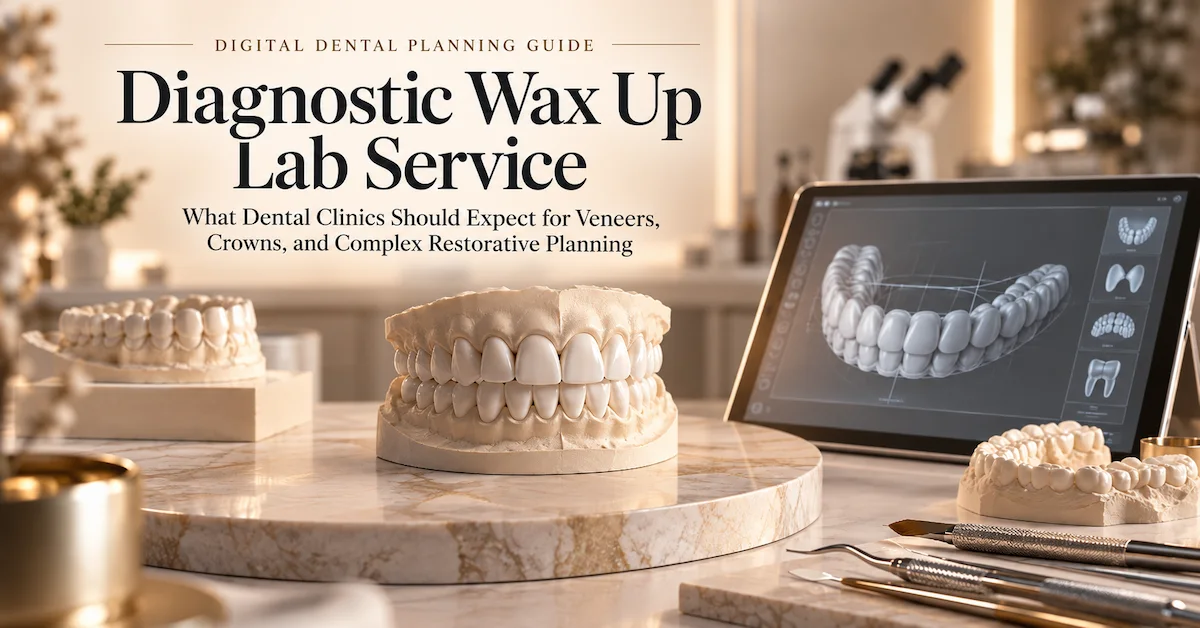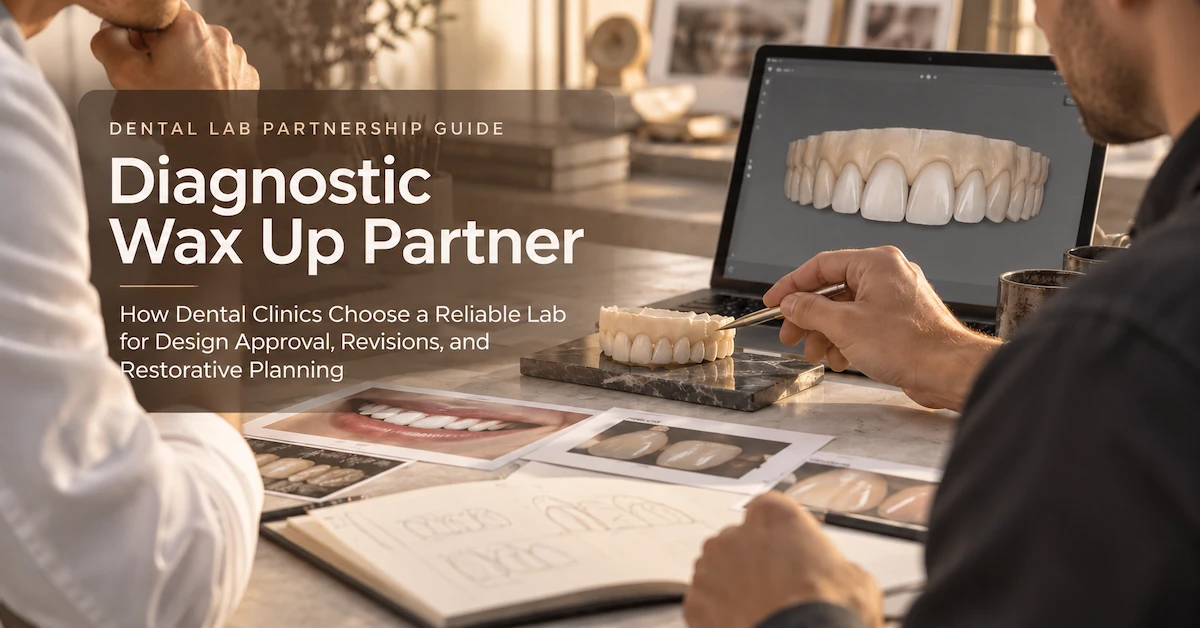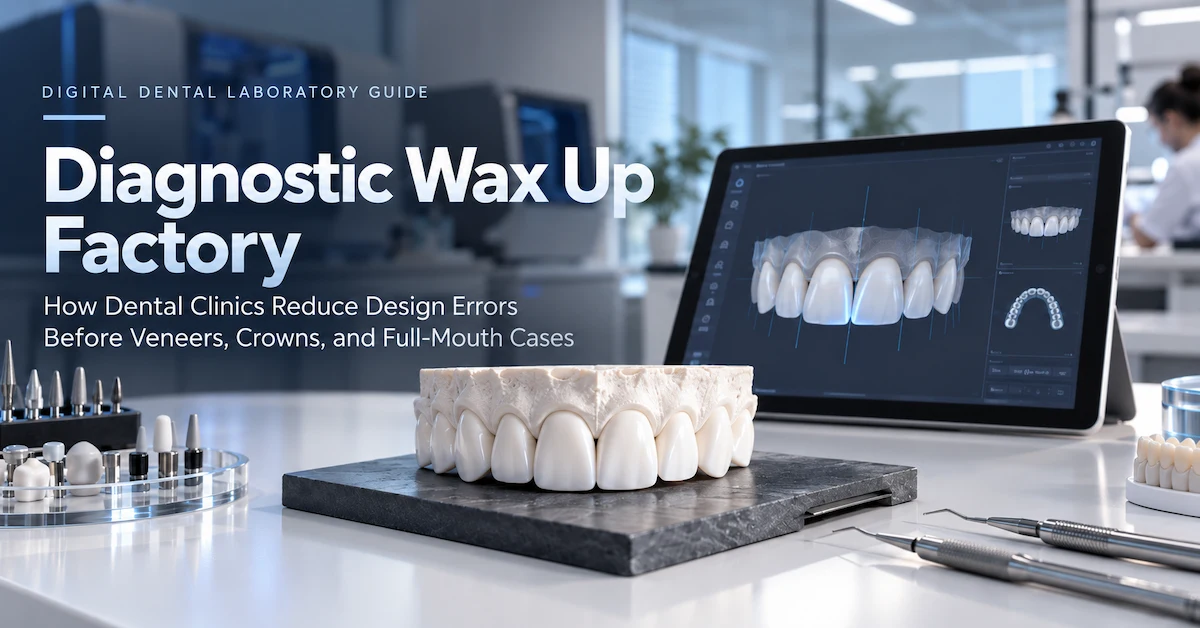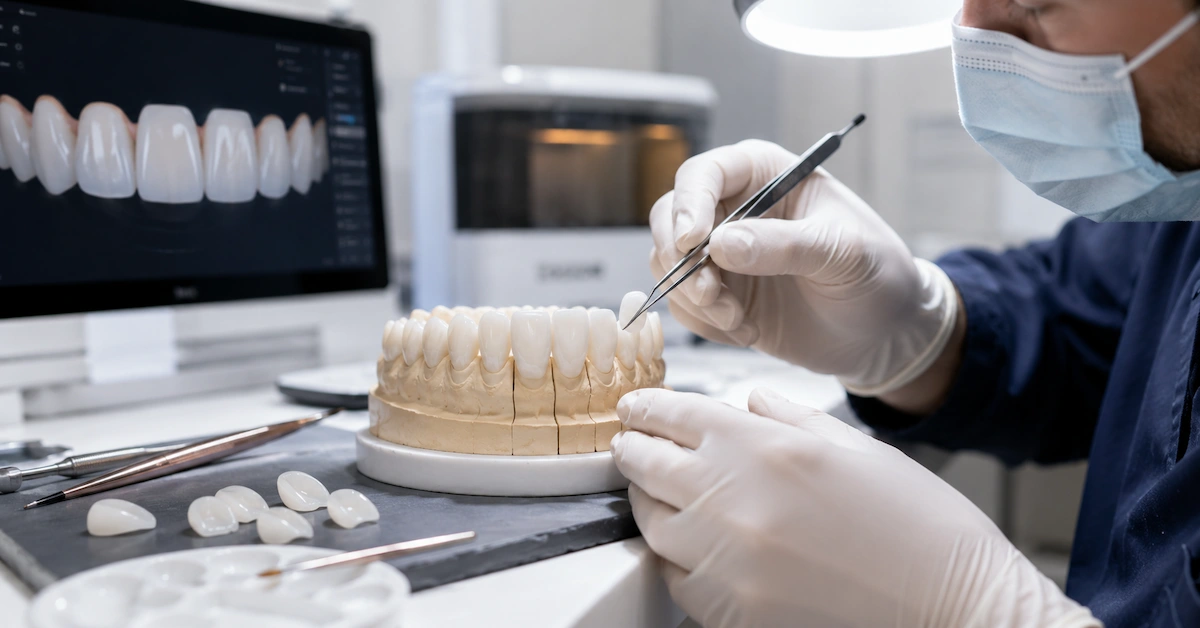

A diagnostic wax up manufacturer should be evaluated on its ability to reproduce an approved planning process, not on whether every patient receives the same tooth shape. For dental service organizations (DSOs), multi-location cosmetic clinics, and overseas laboratory buyers, a structured trial-case program is an effective way to assess digital intake, CAD design, clinical approvals, physical outputs, and communication before increasing order volume.
Quick answer: Qualify a manufacturer with representative cases, a written output specification, defined clinical sign-off, documented revision history, and measurable delivery performance. A wax-up is a diagnostic planning reference—not a guarantee of treatment success, final ceramic fit, or clinical suitability. Those decisions remain with the treating dentist.
Why a Trial-Case Program Matters for Multi-Clinic Buyers
A single practice may have one dentist submitting every aesthetic case. A dental group might have different scanners, tooth-numbering habits, staff members, and preferred design styles at each location. One clinic requests a six-unit veneer proposal; another asks for worn-dentition planning without specifying the bite record. Both orders may be labeled "diagnostic wax-up," although the information and review requirements are different.
A scalable manufacturer should help buyers establish a consistent workflow while preserving patient-specific design decisions. The goal is fewer avoidable questions, clearer approvals, and reliable delivery of the agreed files or models—not standardized smiles.
This approach suits dental groups, aesthetic practices, prosthodontists, and dental labs seeking recurring CAD support. It is less relevant to patients shopping for treatment directly, or practices expecting the laboratory to select tooth preparations, alter vertical dimension, or make other clinical decisions without a dentist's prescription.
Define the Manufacturing Specification Before Sending Trial Cases
Before committing volume to a diagnostic wax up manufacturer, start with a written "case definition." The same checklist should be usable across participating clinics, but each field must allow individualized instructions.
| Specification Field | What the Buyer Should State | Acceptance Evidence |
|---|---|---|
| Case identification | De-identified case ID, clinic code, treating dentist | All files and previews carry the same ID |
| Tooth numbering | Universal or FDI system and exact units | No ambiguity in the intended teeth |
| Input records | Upper/lower STL or PLY scans, bite, relevant photos | Files are readable and correctly associated |
| Clinical objective | Planned restorations, desired morphology, features to preserve | Design can be checked against a written prescription |
| Clinical constraints | Prescribed occlusal relationship, restorative-space limits, relevant treatment sequence | Unresolved questions are returned to the clinician |
| Digital output | Preview images, reviewable geometry, or export format requested | Delivered file type and version match the order |
| Physical output, if needed | Conventional wax model, printed model, or specified transfer reference | Material, model scope, and packaging are agreed |
| Approval and delivery | Authorized approver, revision rules, target review date | Written approval and clear production milestones |
A diagnostic wax-up planning file should not be confused with a definitive veneer or crown specification. Final restorative material, preparation geometry, margins, shade, and clinical fit will require separate decisions and checks. For related restorative capabilities, explore the veneers product category and crown and bridge services.
Which Cases Should Be Included in a Manufacturer Trial?
Instead of choosing only the easiest case, request a small set representing different demands, where ethically appropriate and consistent with each clinician's treatment plan:
-
Anterior aesthetic case: A multi-unit veneer proposal tests smile references, incisal-edge instructions, tooth proportions, and review of visible contours.
-
Restorative planning case: A worn-dentition or multi-unit crown case tests communication of clinically prescribed occlusal records and restorative space; the dentist must define the intended jaw relationship.
-
Cross-location repeatability case: A second clinic submits a different patient with the same group-wide intake template, testing numbering, file organization, and approval clarity.
These are qualification scenarios, not promises that every case requires a wax-up or that a manufacturer can infer missing clinical records. Use anonymized trial records and confirm authorized data handling before sending files.
Compare Diagnostic Wax-Up Production Outputs, Not Just Prices
A diagnostic wax up manufacturer may offer digital design, traditional model work, or selected physical manufacturing, but availability must be verified with the actual provider. The planning service and the downstream manufacturing components are distinct.
| Output Route | Typical Deliverable | Useful For | Confirm Before Ordering |
|---|---|---|---|
| CAD preview only | Labeled visual design views | Remote dentist review | Views, revisions, and whether usable geometry is included |
| CAD plus exported geometry | Approved digital model in agreed format | Subsequent compatible workflows | Export rights, coordinate orientation, and file usability |
| CAD plus printed model | Physical representation of approved design | Model inspection or separately planned transfer | Print material, post-processing, matching version, shipping |
| Conventional wax-up | Physical wax morphology on a diagnostic cast | Analogue or hybrid planning | Cast inputs, handling, shipping, and revision method |
A physical model may be made using appropriate photopolymer resin, whereas conventional diagnostic wax-ups use wax. Neither should be described as a finished zirconia or lithium-disilicate restoration.
A silicone index or mock-up kit is a separate item unless expressly included; see the site's mock-up transfer guide for that distinct clinical handoff.
Seven Quality-Control Gates for Trial-Case Manufacturing
Gate 1 — Validate case identity. Check clinic location, tooth numbering system, indicated arch, file names, and a non-identifying case reference. Misreading FDI and Universal numbers can invalidate an otherwise excellent design.
Gate 2 — Review input suitability. Confirm the intended arches, bite record, and essential photographic references. Incomplete scans, a conflicting bite, or unclear prescribing instructions should trigger a question before CAD work proceeds.
Gate 3 — Record the baseline design. The laboratory should label the first proposed morphology, identify its source records, and show the clinician which structures are being changed. A frontal rendering alone may not show relevant palatal, incisal, or occlusal features.
Gate 4 — Obtain clinical acceptance. The treating dentist checks shape, proportions, planned contours, and any case-specific functional requirements. The manufacturer's technical review is not a substitute for diagnosis, preparation planning, consent, or an individual clinical assessment.
Gate 5 — Control revisions. Identify each request by tooth, feature, and design version. Changes to the treatment plan should be distinguished from corrections needed to meet the original instructions. Do not release an earlier rejected version by mistake.
Gate 6 — Inspect the specified output. If manufacturing a physical model, check case labeling, visible defects, correspondence to approved geometry, and protection in transit. Do not advertise a universal micrometer tolerance without a validated measurement method and relevant evidence.
Gate 7 — Close the case and review performance. Match delivered files or physical items against the signed-off quotation. Record whether the clinic accepted the output, requested clarification, or rejected it for a documented reason. This gives the purchasing team evidence for a recurring-service decision.
Example of Useful Approval Control
Suppose Clinic B reviews design B-024 / V1 and asks to refine the proposed contours of the lateral incisors. The lab issues B-024 / V2, and the dentist approves V2 in writing.
Any requested printed model must be tied to V2, not simply to "the latest design."
This is an illustrative workflow example, not a real patient case or a claim about a particular supplier's software.
How to Score the Pilot Without Inventing Precision Claims
A diagnostic wax up manufacturer qualification program benefits from operational metrics, but buyers should define each measurement before using it.
The following measures are practical internal indicators rather than published Digilabo performance figures:
| Indicator | Calculation or Review | What It Reveals |
|---|---|---|
| Complete-at-intake rate | Complete submissions ÷ trial submissions | Whether the shared clinic template works |
| First-review acceptance rate | Designs approved without revision ÷ designs reviewed | Alignment with the original brief |
| Revision reason distribution | Classify each revision as brief change, lab error, or clinical plan change | Whether problems originate in intake, design, or changing requirements |
| On-time review rate | First designs issued by agreed review date ÷ eligible cases | Reliability of the promised design milestone |
| Output discrepancy count | Cases with wrong version, missing file, or damaged agreed output | Manufacturing and handoff quality |
Do not treat a 100% first-review acceptance rate as the objective of clinical care. A thoughtful dentist may appropriately request changes.
What matters is whether the laboratory handles those changes clearly, records the cause, and provides the correct updated deliverable.
What Does Clinical Evidence Say About Digital Wax-Ups?
Clinical literature supports using diagnostic wax-ups as communication and planning aids, but not a claim that digital designs always outperform conventional techniques.
Simon and Magne, writing in the Journal of the California Dental Association (2008; PMID: 18557126), emphasized correlating the wax-up with the patient's actual smile rather than relying on casts alone.
In a restorative trial published in the International Journal of Esthetic Dentistry (Mocelin and colleagues, 2021; PMID: 34319665), participants appreciated digital scanning convenience, yet their final aesthetic preferences did not uniformly favor digitally produced wax-ups.
This illustrates why manufacturing efficiency and clinical acceptance are different measures. The evidence does not establish a universal success rate for any individual laboratory.
Capacity, Data Protection, and Repeat-Order Terms
Before signing a volume agreement, request concrete answers about technician review, supported files, capacity allocation, backup procedures, data access, confidentiality, and escalation.
A dental group should know who can approve designs, how long records are retained, and how errors are corrected.
Use secure, approved methods for transferring patient information; a marketing contact form is not automatically an appropriate channel for identifiable clinical files.
The laboratory described on the Aspen Dental Labs About Us page operates under the Digilabo Dental Laboratory name and publicly lists CAD/CAM systems, scanners, resin model-printing equipment, and multi-category restorative services.
Its laboratory service workflow describes scan submission, CAD review, and subsequent manufacturing.
These are relevant capabilities to investigate; they do not independently confirm that every digital file type, diagnostic model, transfer index, turnaround, or contractual revision package is available for a proposed order.
A reliable diagnostic wax up manufacturer should provide written answers to those case-specific questions before the buyer treats general factory capabilities as a service guarantee.
Ask for applicable certificates or quality records where relevant; do not assume regulatory approval of a particular product from the laboratory's general marketing claims.
Diagnostic Wax-Up Cost: Compare Total Case Cost
The lowest unit price is rarely the whole commercial picture. For a trial program, compare like-for-like scopes:
-
Design fee: Units and arches covered, complexity, and source records.
-
Review and revisions: Included rounds, response times, and charges for treatment-plan changes.
-
Outputs: Preview images, exportable geometry, models, and any separately contracted transfer components.
-
Production and logistics: Material, handling, packaging, international freight, and destination requirements.
-
Correction policy: What happens if the delivered item fails the agreed technical specification.
Also separate four dates: records accepted, first design ready, clinician approval, and physical arrival.
Missing records and delayed approvals can affect the schedule. Do not promise a fixed price or dispatch window until the manufacturer confirms the requested work.
Request a Trial-Case Manufacturing Proposal
For a multi-clinic pilot, ask the manufacturer to quote the same standardized brief for each participating location, while keeping each patient's clinical objectives separate.
A concise first inquiry can say:
We manage [number] dental clinics and would like to evaluate diagnostic wax-up support using [two/three] representative cases. We use [scanner or file types] and need [CAD preview / exportable design / optional physical model]. Please confirm record requirements, technical review, design approval, revision policy, output options, pilot pricing, secure submission arrangements, and review/delivery milestones before we proceed to recurring orders.
Use the Aspen Dental Labs contact page to discuss the program and request a case-specific quotation.
Confirm the appropriate secure channel before transmitting patient information.
Frequently Asked Questions
1. What does a diagnostic wax up manufacturer produce?
It may produce a digital proposed tooth design, a conventional wax-up, or an agreed physical diagnostic model. The precise deliverable depends on the manufacturer's capabilities and the contract; a visual CAD preview is not automatically an editable manufacturing file.
2. Why should dental groups qualify a manufacturer with trial cases?
Representative trials test file compatibility, clinical communication, design revisions, output verification, and schedules before a large volume commitment. They also reveal differences between clinic submission habits.
3. Is a diagnostic wax-up suitable for every dental case?
No. Its value depends on the patient's treatment plan and the dentist's need to evaluate proposed morphology. Simple cases may not require the same planning outputs as multi-unit aesthetic or complex restorative cases.
4. Can a manufacturer work from STL or PLY scans?
Digital laboratories commonly use such files, but each supplier must confirm compatibility and whether opposing scans, bite records, photographs, and prescribed design instructions are also needed.
5. Should clinics submit the same wax-up design for different patients?
No. Groups can standardize instructions, numbering, and approval formats, but tooth morphology and clinical constraints must remain patient-specific. Reusing a workflow is different from copying an individualized design.
6. Who approves tooth shape and occlusal changes?
The treating dentist approves clinical suitability and any proposed changes related to treatment. The technician can identify technical problems and execute the prescription but should not independently determine clinical treatment.
7. Are printed models and silicone indexes included?
Not necessarily. Request separate confirmation of physical model production, transfer components, materials, charges, and dispatch. Digital-only design quotations should not be treated as physical model quotations.
8. How should design revisions be priced?
Agree on included review rounds and distinguish supplier corrections from new clinical requests. Record design versions and ask for written authorization before chargeable additional work.
9. What turnaround should a multi-clinic buyer expect?
The schedule depends on case complexity, complete records, review cycles, any physical manufacturing, and shipping destination. Ask for dated milestones rather than assuming a quoted design turnaround includes international arrival.
10. What should we send to request a pilot quote?
Provide clinic locations, case types, estimated volume, tooth counts, available scan formats, required deliverables, approval process, and target dates. Ask the lab to confirm secure submission and actual service availability before sending clinical data.
Conclusion
Choosing a diagnostic wax up manufacturer for recurring clinic orders is a production-control decision as well as an aesthetic one. A strong pilot program checks case identity, source records, prescribed morphology, CAD revisions, clinician approval, physical outputs when required, and delivery reliability.
Standardize the process across clinics without standardizing patients' smiles, and evaluate total case cost rather than a headline per-unit price.
The laboratory services presented on Aspen Dental Labs offer a starting point for discussing digital restorative workflows. To evaluate whether the available diagnostic wax-up options suit your clinics, contact Aspen Dental Labs with your proposed trial-case scope and request a tailored manufacturing discussion.