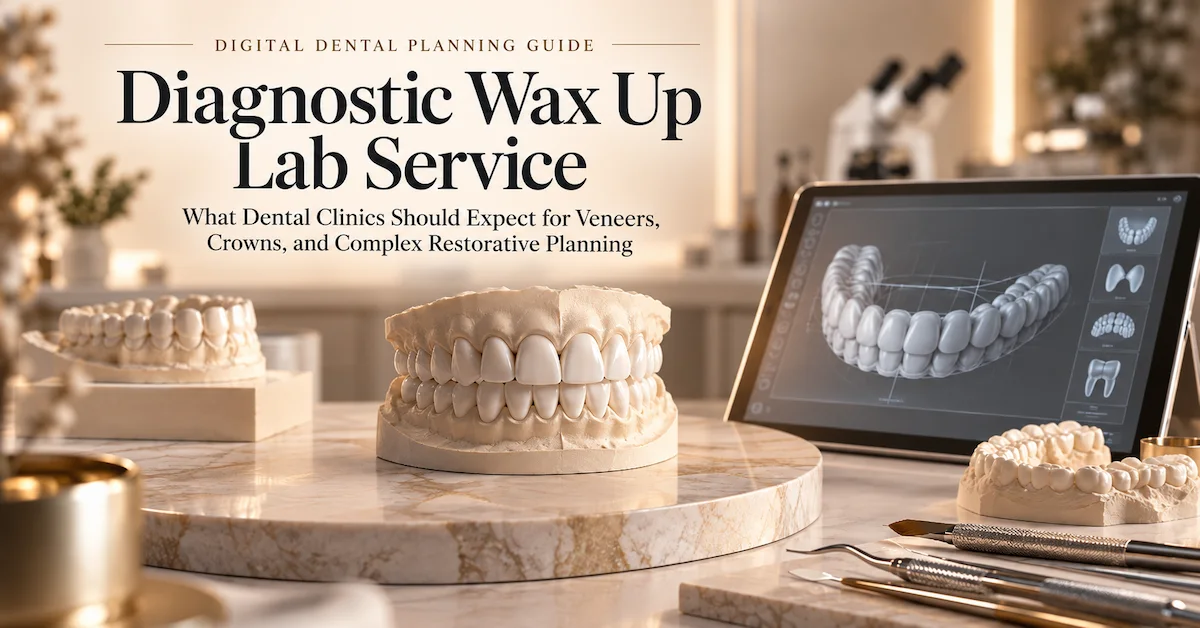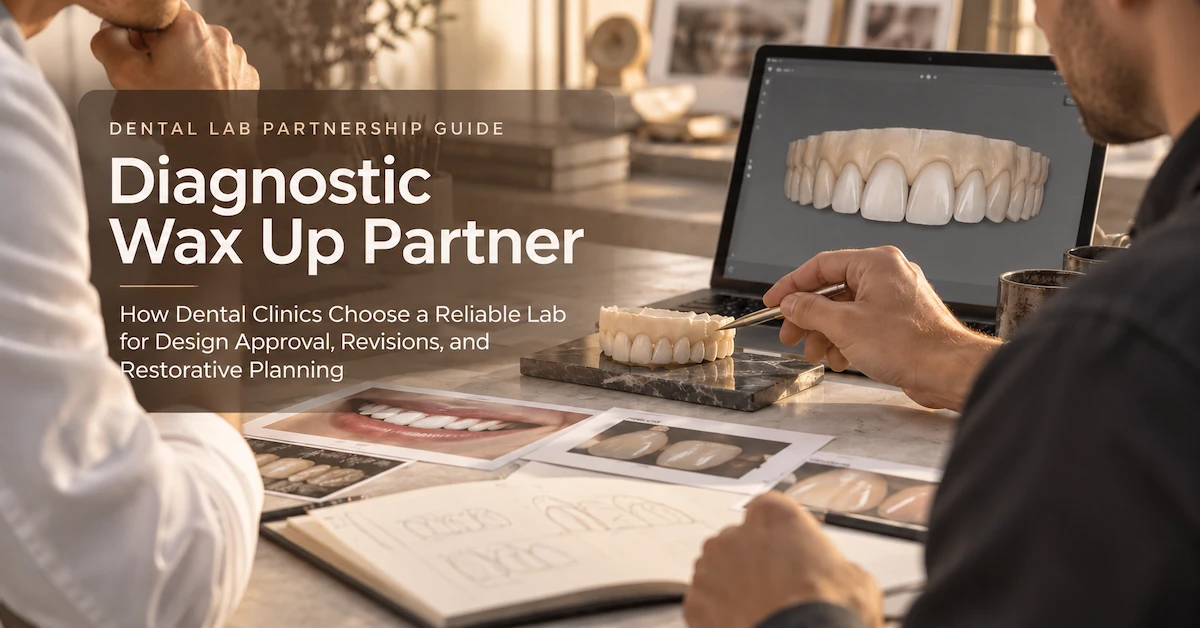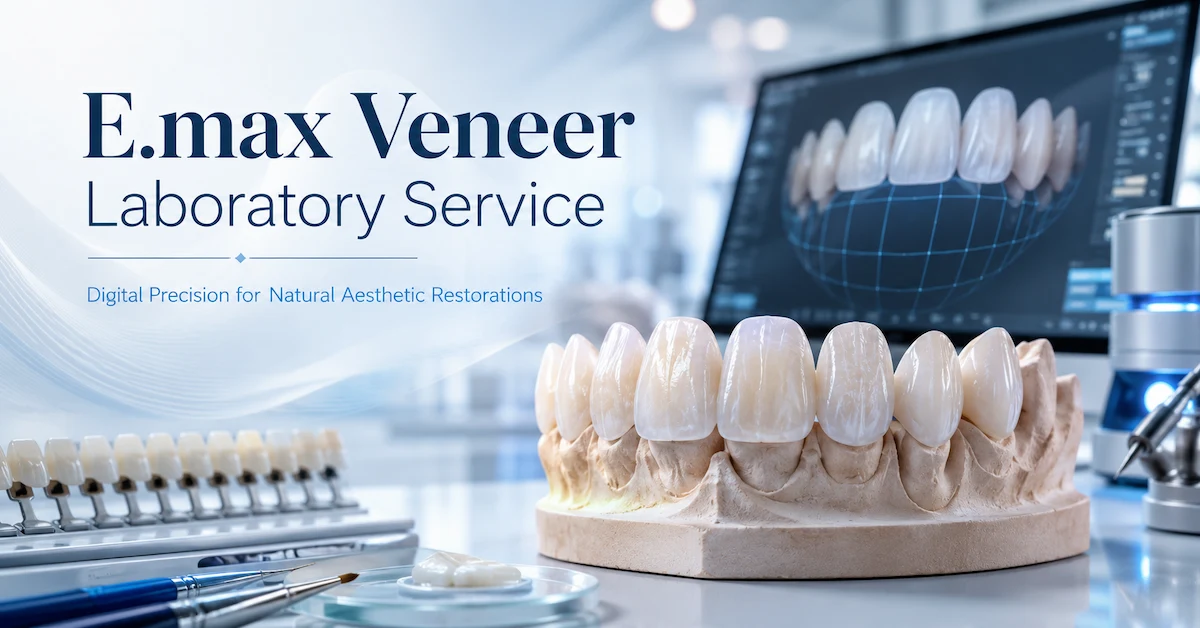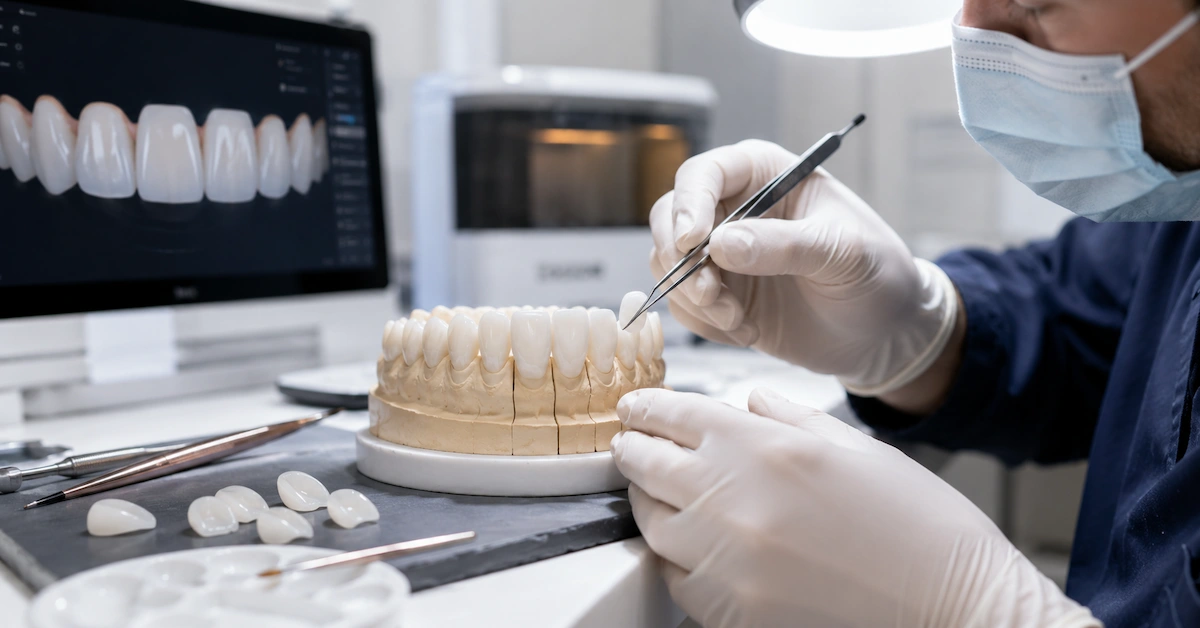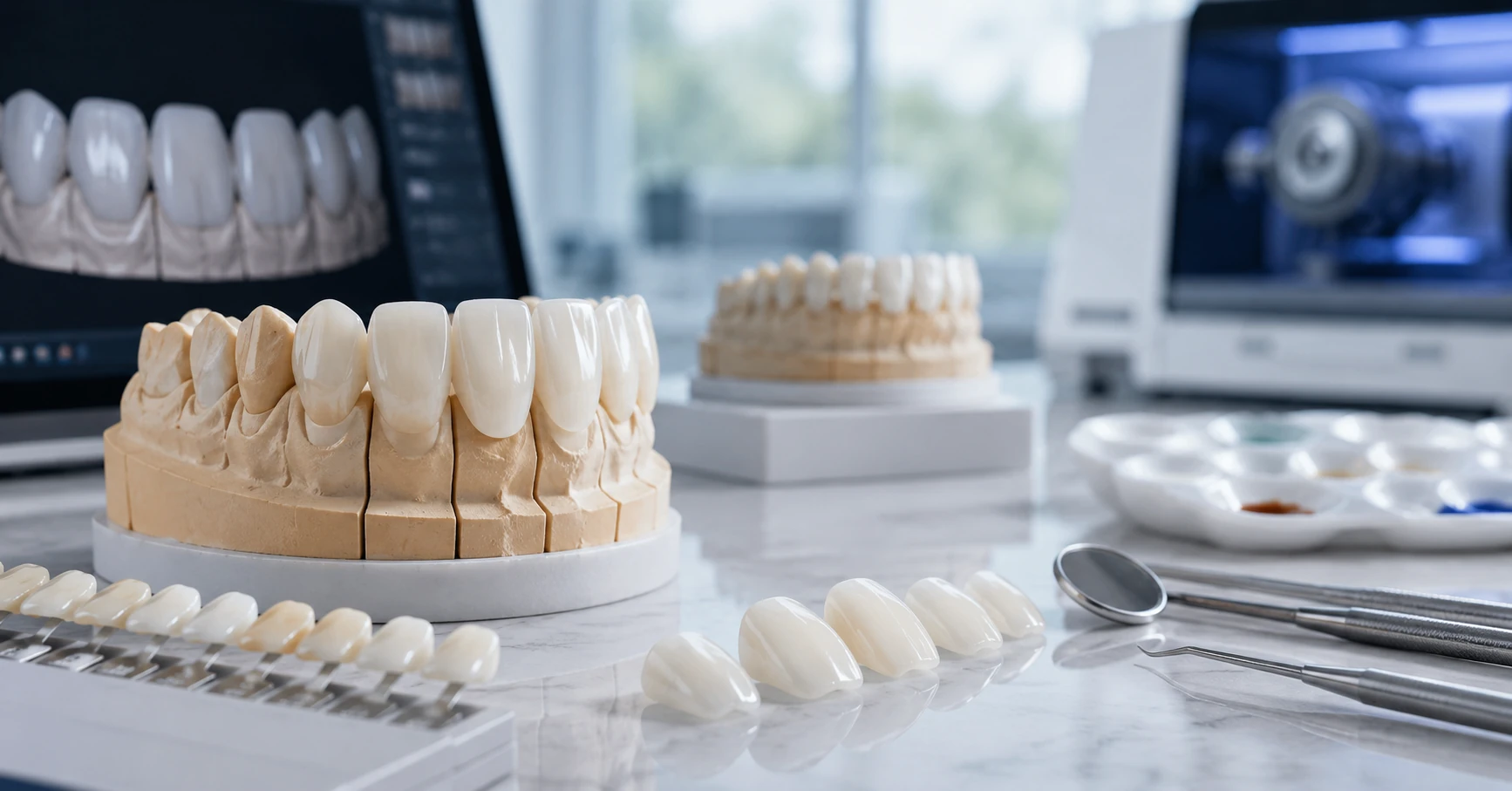

A diagnostic wax-up is much more than a model that shows how teeth might look after treatment. For a dentist, prosthodontist, or cosmetic clinic, it can become a practical decision-making tool before irreversible preparation or final restoration production begins.
That is why choosing a reliable diagnostic wax up factory or dental laboratory should not be treated as a simple purchasing decision.
The real question is whether the laboratory can translate clinical records, scans, photographs, occlusal information, aesthetic goals, and restorative requirements into a useful treatment-planning design.
A well-planned wax-up may help the clinician evaluate tooth length, width, proportion, midline, incisal edge position, restorative space, occlusal relationships, and the overall direction of the proposed case. It can also provide a reference for patient communication, mock-ups, provisional restorations, preparation planning, and final restorative design.
A poor wax-up does the opposite. It may look attractive on a screen yet fail to reflect the patient's actual bite, available restorative space, preparation limitations, or treatment objectives.
For clinics outsourcing complex aesthetic and restorative cases, the difference often comes down to the quality of the laboratory workflow.
At Digilabo Dental Laboratory, Diagnostic Wax-Ups sit within the broader veneer and aesthetic-restoration workflow. The goal is not simply to create ideal-looking teeth, but to build a design that gives the dentist useful information before proceeding to the next clinical or laboratory stage.
This guide explains what dental clinics should expect from a professional diagnostic wax-up service, what information should be submitted, how digital and conventional approaches differ, where errors usually occur, and how to evaluate a laboratory before outsourcing recurring cases.
What Is a Diagnostic Wax-Up?
A diagnostic wax-up is a planned representation of a proposed restorative outcome created before definitive treatment is completed.
Traditionally, technicians added wax to stone models to modify tooth form and simulate the intended restoration. Modern laboratories can also create the design digitally from intraoral scans or scanned models using CAD software.
The fundamental purpose remains the same: the wax-up allows the dental team to study the proposed result before committing to final treatment.
Depending on the case, a diagnostic wax-up can help evaluate:
-
Tooth length and width
-
Tooth proportions
-
Incisal edge position
-
Arch form
-
Midline
-
Axial inclination
-
Contact relationships
-
Emergence profile
-
Occlusal morphology
-
Available restorative space
-
Smile symmetry
-
Planned additive changes
-
Areas that may require preparation
-
Relationship between the proposed restorations and adjacent dentition
For cosmetic cases, it can also provide a visual bridge between what the patient requests and what the clinical team considers realistic.
For restorative cases, it becomes a communication reference between dentist and technician.
For larger rehabilitations, it can serve as one component of a more detailed planning workflow.
This is why searching for a diagnostic wax up factory often reflects more than a need to purchase a model. The buyer is usually looking for a laboratory partner that can support repeatable treatment planning.
Who Usually Needs a Diagnostic Wax-Up Service?
The service can be useful across several types of dental practices.
Cosmetic Dental Clinics
Cosmetic dentists commonly use diagnostic wax-ups when planning:
-
Porcelain veneers
-
E.max veneers
-
Anterior crowns
-
Smile makeovers
-
Diastema closure
-
Changes in tooth proportion
-
Worn anterior teeth
-
Multi-unit aesthetic restorations
For these cases, small differences in length, contour, symmetry, and line angles can significantly affect the visual result.
A wax-up creates an opportunity to review those decisions before the final ceramic restorations are fabricated.
Clinics already working with veneers and aesthetic restorations may therefore treat the wax-up as a separate approval stage rather than moving directly from scan to final restoration.
Prosthodontists
Prosthodontists may require a more detailed diagnostic wax-up for cases involving:
-
Multiple crowns
-
Worn dentition
-
Complex occlusion
-
Changes in vertical dimension
-
Full-mouth rehabilitation
-
Implant-supported restorations
-
Combined restorative treatment
In these situations, the wax-up is not simply an aesthetic preview.
Functional relationships become increasingly important.
General Dental Practices
General dentists may use wax-ups for cases that are too complex to plan confidently from a preparation scan alone.
Examples include:
-
Several adjacent crowns
-
Anterior rehabilitation
-
Larger veneer cases
-
Replacement of heavily restored teeth
-
Reorganization of tooth form before treatment
Implant and Full-Arch Clinics
In implant treatment, prosthetic planning may need to occur before or alongside surgical planning.
A diagnostic design can help the team discuss:
-
Intended tooth position
-
Prosthetic envelope
-
Restorative space
-
Aesthetic reference
-
Occlusal arrangement
-
Expected final contours
The diagnostic wax-up is only one part of implant planning and should not replace appropriate clinical, radiographic, surgical, or prosthodontic assessment.
Dental Laboratories Outsourcing Design Work
Smaller laboratories may also outsource wax-up design when internal CAD capacity is limited or case volume increases.
For these buyers, consistency, file organization, revision management, and delivery speed can be as important as artistic design.
Why Clinics Use a Diagnostic Wax-Up Before Final Restorations
The simplest explanation is that changing a design is easier before the final restoration has been manufactured.
Consider a six-unit anterior veneer case.
If the patient feels the proposed central incisors are too long during the planning stage, the design can be reconsidered before final ceramic production.
If the same concern appears after all six veneers have been fabricated, the consequences may include:
-
Additional chair time
-
Laboratory adjustment
-
Remake requests
-
Delayed delivery
-
Rescheduled appointments
-
Patient dissatisfaction
-
Increased cost for both clinic and laboratory
This does not mean that a diagnostic wax-up guarantees the final result.
It means that it introduces an earlier point where important design questions can be identified and discussed.
A strong diagnostic wax up factory therefore provides value by improving the information available before final manufacturing begins.
Digital Diagnostic Wax-Up vs Conventional Wax-Up
Both approaches can be useful. The appropriate option depends on the clinic's workflow, case complexity, available records, and intended use.
| Factor | Digital Diagnostic Wax-Up | Conventional Wax-Up |
|---|---|---|
| Starting data | Intraoral scan or scanned model | Physical stone model |
| Design method | CAD software | Manual wax application |
| Revision | Digital modification | Manual modification |
| File storage | Can be archived digitally | Physical model storage required |
| Remote approval | Easier to share digitally | Usually requires photos or shipment |
| Replication | Digital files can support repeat production | May require duplication of model |
| Physical evaluation | Can be 3D printed if required | Physical model already available |
| Best fit | Digital clinics, overseas outsourcing, repeated revisions | Traditional workflows and selected physical cases |
Digital workflows have become particularly useful for international dental laboratory cooperation because case data can be transmitted electronically.
A clinic can submit STL or PLY files, photographs, bite data, and a prescription instead of shipping the initial diagnostic model internationally.
The laboratory can then design the proposed wax-up and send a digital preview for review.
Where a physical reference is required, the approved design may then be converted into a printed model or other physical output depending on the agreed workflow.
Digilabo's broader digital dental laboratory workflow is built around this type of scan-to-design process.
What Information Should a Clinic Send to a Diagnostic Wax Up Factory?
One of the biggest causes of poor outsourcing results is incomplete case information.
A technician cannot reliably infer every clinical objective from a scan alone.
A strong submission should tell the laboratory both what exists now and what the dentist wants to change.
1. Upper and Lower Arch Scans
Where the workflow is digital, submit complete scans rather than only isolated prepared teeth.
The technician may need surrounding anatomy to understand:
-
Arch relationship
-
Neighboring tooth shape
-
Symmetry
-
Contact positions
-
Occlusal anatomy
2. Bite Record
The bite should reflect the clinical situation that the laboratory is expected to use.
Incomplete or inaccurate interarch information can affect the usefulness of the design.
3. Facial and Smile Photographs
For aesthetic cases, intraoral geometry alone does not provide every facial reference.
Useful photographs may include:
-
Full-face smile
-
Natural smile
-
Retracted anterior view
-
Frontal intraoral view
-
Lateral views
-
Occlusal views when relevant
The dentist should also identify which photographs should be treated as the primary aesthetic reference.
4. Current Clinical Condition
Explain whether the case involves:
-
Existing restorations
-
Tooth wear
-
Fractures
-
Missing teeth
-
Diastema
-
Rotation
-
Gingival asymmetry
-
Implant-supported units
-
Planned extractions
-
Planned crown lengthening
-
Orthodontic changes
The wax-up should reflect the treatment plan rather than assume that every visible condition remains unchanged.
5. Number of Planned Restorations
A four-unit veneer case and a ten-unit smile rehabilitation require different planning considerations.
Specify the proposed treatment area.
6. Desired Tooth Form
Useful instructions might describe:
-
More square or rounded incisors
-
Youthful or mature anatomy
-
Stronger or softer line angles
-
Desired canine prominence
-
Incisal character
-
Symmetry preferences
"Make it beautiful" is not a technical instruction.
7. Requested Changes
Be specific.
For example:
-
Close 1 mm central diastema
-
Increase central incisor length
-
Maintain canine length
-
Correct visible lateral incisor asymmetry
-
Reduce excessive facial prominence
-
Do not widen posterior corridor
-
Preserve existing midline
Specific instructions reduce interpretation errors.
8. Restorative Plan
Tell the laboratory what will eventually be manufactured.
A diagnostic design for minimally prepared veneers may have different constraints from a design intended for full-coverage crowns.
9. Occlusal Considerations
Complex cases should include appropriate clinical information regarding the intended occlusal plan.
The laboratory should not independently diagnose or redefine the patient's clinical treatment objective.
10. Deadline and Review Requirements
Tell the laboratory whether the clinic needs:
-
Digital design only
-
Physical printed model
-
Revision stage
-
Mock-up support
-
Provisional reference
-
Final restoration planning
-
A specific appointment deadline
Clear deliverables prevent misunderstandings.
A Practical Digital Wax-Up Workflow
A professional workflow should have identifiable stages rather than a technician simply returning a finished file without explanation.
Step 1: Case Intake
The laboratory receives:
-
Scan data
-
Prescription
-
Bite information
-
Photos
-
Tooth-form request
-
Restoration plan
-
Special notes
The first task should be checking whether the case information is sufficient.
If important records are missing, designing immediately may save time at the beginning but create problems later.
Step 2: Data Review
Before designing, the technician reviews:
-
Scan completeness
-
Bite relationship
-
Visible tooth anatomy
-
Treatment area
-
Space available for planned changes
-
Photograph quality
-
Prescription clarity
Questions should be returned to the clinic early.
Step 3: Initial CAD Design
The technician develops the proposed morphology.
Depending on the case, this may involve changes to:
-
Tooth length
-
Width
-
Facial contour
-
Incisal edge
-
Line angles
-
Interproximal form
-
Arch relationship
-
Occlusal anatomy
The goal is not to produce identical textbook teeth.
The design should respond to the patient's existing anatomy and the dentist's treatment objective.
Step 4: Clinical Review
The clinic reviews the design before final approval.
This stage is particularly important in multi-unit aesthetic cases.
Possible feedback might include:
-
Shorten teeth 8 and 9
-
Reduce lateral incisor width
-
Increase canine prominence
-
Move the midline
-
Modify embrasures
-
Change facial contour
-
Adjust posterior anatomy
Step 5: Revision
Requested changes are incorporated into the design.
A reliable dental wax-up laboratory should maintain clear version control so that both sides know which design is current.
Step 6: Approval
The dentist approves the planning design.
Approval should mean that the proposed morphology is accepted for the agreed purpose.
It should not be confused with approval of every later clinical or restorative variable.
For example, approving a wax-up does not automatically approve final ceramic shade, surface characterization, cementation, implant positioning, or preparation quality.
Step 7: Downstream Use
Depending on the treatment plan, the approved design may support:
-
Printed diagnostic models
-
Mock-up procedures
-
Preparation guides
-
Provisional restorations
-
Silicone indexes
-
Final CAD references
-
Patient communication
Digilabo's service workflow similarly uses a process of file submission, design review, approval, production, quality control, and shipment across digital laboratory cases.
What Makes a High-Quality Diagnostic Wax-Up?
A visually attractive 3D rendering is not enough.
Clinics should evaluate several separate dimensions.
1. Tooth Proportion
The design should make sense as a complete smile rather than as individual isolated teeth.
The technician may review relationships between:
-
Central incisors
-
Lateral incisors
-
Canines
-
Premolars
-
Existing neighboring teeth
Proportions should also reflect the specific clinical objective.
2. Symmetry Without Looking Artificial
Perfect mathematical symmetry does not automatically equal natural aesthetics.
Natural teeth contain controlled variation.
The technician's task is to create appropriate harmony without producing a repetitive, artificial appearance.
3. Incisal Edge Position
Small changes in incisal length may influence:
-
Smile appearance
-
Tooth display
-
Phonetics
-
Occlusal relationships
-
Restorative space
For this reason, dentists should provide appropriate clinical guidance rather than leaving incisal changes entirely to laboratory interpretation.
4. Facial Contour
Over-contoured proposed restorations may look acceptable in an isolated digital rendering while becoming problematic clinically.
The design should consider available space and the intended preparation strategy.
5. Emergence and Cervical Form
Cervical design can affect how the proposed restoration visually integrates with the gingival architecture.
If periodontal or surgical changes are planned, the laboratory needs to know.
6. Contact and Embrasure Design
Aesthetic wax-ups should not treat teeth as separate pieces.
Interproximal relationships influence the overall appearance and downstream restorative design.
7. Functional Awareness
A cosmetic wax-up still exists within a functioning dentition.
The laboratory should evaluate the records supplied by the clinician and avoid designing morphology in isolation.
Complex functional planning remains the responsibility of the clinical team.
How Diagnostic Wax-Ups Support Veneer Cases
Veneer cases are one of the most common reasons clinics search for a diagnostic wax up factory.
Why?
Because veneers are highly visible, and the treatment often depends on controlling relatively small morphological changes.
A diagnostic wax-up can help the dentist evaluate:
-
Final tooth length
-
Facial contour
-
Diastema closure
-
Lateral incisor proportions
-
Incisal embrasures
-
Canine transition
-
Smile symmetry
For multi-unit cases, it also creates a shared visual reference between patient, dentist, and technician.
Digilabo's guide to selecting a smile design veneers lab identifies diagnostic wax-ups and digital previews as useful planning tools before final veneer fabrication.
That planning stage becomes especially valuable when patient expectations are high.
Instead of discussing "slightly longer" or "more natural" teeth only with words, the team has a concrete design to review.
Diagnostic Wax-Ups for Crowns and Bridges
Wax-ups are not limited to cosmetic veneers.
For crown and bridge cases, they may support treatment planning when the dentist wants to:
-
Re-establish worn anatomy
-
Modify tooth proportions
-
Evaluate pontic position
-
Plan multiple adjacent restorations
-
Coordinate provisional and final contours
-
Assess restorative space
A larger restorative case should not automatically move directly to final manufacturing simply because a digital scan is available.
The scan describes the existing situation.
The wax-up describes a proposed restorative direction.
Those are different functions.
Clinics can review Digilabo's broader dental product categories when planning how a wax-up may connect with later zirconia, ceramic, crown, bridge, implant, or removable workflows.
Full-Mouth Rehabilitation and Worn Dentition
Full-mouth cases demand more information and more disciplined communication than a small cosmetic case.
Potential considerations may include:
-
Existing tooth wear
-
Occlusal relationships
-
Vertical dimension
-
Restorative space
-
Arch form
-
Missing teeth
-
Implant positions
-
Proposed restorative material
-
Provisional strategy
A diagnostic wax-up may be useful as part of this planning process, but it must remain tied to the clinician's diagnosis and treatment plan.
This distinction matters.
A laboratory can design restorations from the information supplied. It does not replace the dentist's clinical examination, radiographs, functional assessment, periodontal evaluation, or diagnosis.
For complex rehabilitation, the best results usually come from a collaborative dentist-technician workflow.
Digital Wax-Up vs Digital Smile Design
These terms are sometimes used interchangeably, but they are not always identical.
Digital smile design often emphasizes the visual relationship between the proposed teeth, smile, lips, and face.
A digital diagnostic wax-up produces three-dimensional tooth morphology that can potentially be transferred into physical or restorative workflows.
A case may use both.
For example:
-
Facial photographs help establish the aesthetic objective.
-
A smile design concept defines general length and proportion.
-
A 3D wax-up translates that concept into tooth morphology.
-
A printed model or mock-up allows further evaluation.
-
Final restorations use the approved design as one reference.
When comparing suppliers, ask exactly what is included.
A "smile preview" may only be a visual image.
A "digital wax-up" may include actual CAD geometry.
These deliverables should not be assumed to be the same.
Common Problems When Outsourcing Diagnostic Wax-Ups
Understanding failure points makes it easier to select a supplier.
Problem 1: The Laboratory Designs Without Enough Information
The clinic sends an upper scan and writes:
"Make 8 beautiful veneers."
The technician has no reliable information about:
-
Patient expectations
-
Facial relationship
-
Bite
-
Preferred length
-
Existing asymmetry to maintain or correct
-
Preparation strategy
The result may look polished but still be clinically unhelpful.
Better approach: Submit structured instructions.
Problem 2: The Design Is Too Idealized
Some digital designs look like a library of perfect teeth placed over the patient's existing dentition.
This may create excessive changes that are difficult to achieve conservatively.
Better approach: Ask the laboratory to design around the prescribed treatment strategy.
Problem 3: No Clear Revision Process
If revisions are communicated through scattered messages without design version numbers, mistakes become more likely.
Better approach: Keep feedback organized and confirm which version is approved.
Problem 4: Dentist and Patient Approval Are Confused
A patient may approve a visual smile concept, while the dentist still has technical concerns.
These are different approvals.
Better approach: Separate aesthetic feedback from clinical approval.
Problem 5: Wax-Up Approval Is Treated as Final Restoration Approval
Final restorations contain additional variables, including:
-
Material
-
Shade
-
Translucency
-
Preparation
-
Margin
-
Cement space
-
Occlusion
-
Surface finish
Better approach: Treat the wax-up as one stage in a larger workflow.
Problem 6: The Laboratory Does Not Understand the Intended Next Step
The technician may create a design for visualization when the clinic needs a model for a mock-up, provisionals, or a final CAD reference.
Better approach: Define the downstream use before design begins.
How to Evaluate a Diagnostic Wax Up Factory Before Sending Cases
Price alone is a weak selection criterion.
A clinic planning repeat aesthetic or restorative cases should evaluate the supplier as a technical partner.
Ask About Accepted Files
A digital laboratory should clearly state what it can receive.
Examples may include:
-
STL
-
PLY
-
Digital prescriptions
-
Scan codes
-
Photographs
Ask About Design Review
Can the clinic review the design before production?
Can revisions be requested?
How are changes documented?
Ask Who Designs the Case
A factory-style operation may have production capacity, but complex wax-ups still require technician judgment.
Ask how cases are assigned and reviewed.
Ask How Aesthetic Information Is Communicated
For anterior cases, the laboratory should have a practical method for receiving:
-
Smile photographs
-
Tooth-shape references
-
Desired length
-
Midline instructions
-
Patient preferences
Ask About Physical Outputs
If a printed model is required, confirm:
-
Whether printing is included
-
Whether it is optional
-
What model will be delivered
-
Whether the design file is retained
Ask About Revision Policy
Before placing recurring cases, understand:
-
Number of included revisions
-
Revision turnaround
-
What constitutes a new design
-
How major treatment-plan changes are handled
Ask About Data Storage
Digital archiving can make future reference and remake workflows easier, but clinics should understand what data the laboratory stores and for how long.
Ask About Related Restorative Capabilities
A laboratory that also produces the final restorations may offer a smoother transition from planning to manufacturing because the approved design can remain within the same production system.
Digilabo supports a wider range of restorative and dental laboratory services, allowing clinics to use wax-up planning as part of a broader workflow rather than as an isolated service.
Diagnostic Wax-Up Factory vs Freelance CAD Designer
Both can be appropriate in different situations.
| Factor | Full Dental Laboratory | Freelance CAD Designer |
|---|---|---|
| Diagnostic design | Yes | Often |
| Physical model production | Usually available | May require third party |
| Final restoration production | Available | Usually not |
| Veneer/crown transition | Integrated | Separate supplier needed |
| QC system | Laboratory dependent | Individual dependent |
| Capacity | Usually higher | Usually lower |
| Complex workflow coordination | Often broader | Design-focused |
| Best for | Clinics needing planning + production | Clinics needing design only |
A freelance designer can be useful if a clinic or laboratory only needs CAD support.
A full diagnostic wax up factory becomes more attractive when the buyer wants the diagnostic design to connect directly with later restorations, printed models, veneers, crowns, or other laboratory work.
What Determines Diagnostic Wax-Up Cost?
It is difficult to define one universal price because case complexity varies considerably.
Cost may depend on:
-
Number of teeth
-
Digital vs physical workflow
-
Case complexity
-
Aesthetic requirements
-
Occlusal complexity
-
Number of revisions
-
Physical model requirements
-
Rush turnaround
-
Additional design services
-
Shipping requirements
A simple two-tooth additive wax-up should not necessarily be priced like a full-arch rehabilitation.
For purchasing teams, the more useful question is:
What is included in the quoted service?
Ask whether the quotation includes:
-
CAD design
-
Revision
-
Printed model
-
Design preview
-
File storage
-
Shipping
-
Additional planning outputs
A low initial quotation can become expensive if every revision or physical output is charged separately.
What Determines Turnaround Time?
Turnaround is influenced by more than laboratory speed.
Common variables include:
-
Completeness of submitted records
-
Number of units
-
Complexity
-
Need for clinical clarification
-
Number of revision cycles
-
Physical manufacturing
-
International logistics
Clinics can shorten the process by sending complete records at the beginning.
A missing bite or unclear prescription may cost more time than the actual CAD design.
For time-sensitive cases, tell the laboratory the patient's appointment date when the case is submitted rather than after the first design is finished.
How a Diagnostic Wax-Up Can Help Reduce Remake Risk
A wax-up does not eliminate remakes.
It does, however, create another opportunity to detect mismatched expectations early.
Consider these two workflows.
Workflow A
Scan → Final veneer production → Patient sees proposed shape at insertion.
Workflow B
Scan → Diagnostic wax-up → Review → Revision → Approval → Final veneer production.
Workflow B includes an additional decision point.
That extra step costs time and money, but it may be valuable when morphology and patient expectations are difficult to communicate verbally.
For high-value multi-unit cases, an additional planning stage may be more economical than discovering a fundamental design disagreement after final manufacturing.
Why Standardized Case Submission Matters for Multi-Location Clinics
Dental groups and DSOs have a different challenge from a single cosmetic dentist.
Their goal is not only to produce one successful case.
They also need consistency across:
-
Multiple dentists
-
Multiple locations
-
Different scanners
-
Different clinical teams
-
Different patient expectations
Without a standardized prescription, the laboratory receives completely different instructions from each clinic.
One dentist sends eight photos and detailed notes.
Another sends one scan and writes "wax up 6–11."
The laboratory cannot create a standardized result from non-standardized inputs.
A multi-location practice should consider creating a diagnostic wax-up submission template containing:
-
Doctor
-
Clinic
-
Patient ID
-
Tooth numbers
-
Planned restorations
-
Desired changes
-
Scan files
-
Bite
-
Required photographs
-
Tooth-form preference
-
Material plan
-
Deadline
-
Required output
-
Revision contact
This improves communication regardless of which laboratory produces the case.
Why “Factory” Capacity Still Matters
Dentistry is highly technical, and the word "factory" should never imply that diagnostic designs can be produced like identical industrial parts.
Every patient is different.
However, production capacity still matters for large buyers.
A larger laboratory system may offer advantages in:
-
Case tracking
-
Dedicated departments
-
CAD capacity
-
3D printing capacity
-
Standardized QC
-
International shipping
-
Recurring case management
-
Support for larger clinic groups
Digilabo describes its laboratory and technical capabilities on the About Us page and supports multiple restorative, implant, removable, orthodontic, and aesthetic workflows.
For buyers, the ideal combination is not mass production alone.
It is scalable production with case-specific design control.
Why Communication Often Matters More Than Software
Many laboratories use capable CAD systems.
Software alone does not create a predictable case.
Two technicians can receive the same scan and create very different designs because they interpret the prescription differently.
Strong communication therefore becomes a competitive advantage.
A useful laboratory relationship should allow the dentist to explain:
-
What should change
-
What should remain unchanged
-
Which feature matters most
-
What the patient dislikes
-
Which compromises are acceptable
-
Which clinical limitations must be respected
This is particularly important when working across countries and time zones.
Clear digital communication is often more valuable than vague claims such as "advanced technology" or "high quality."
What Should Clinics Check Before Approving a Wax-Up?
Before approval, use a structured review rather than looking only at the overall smile.
Aesthetic Review
Check:
-
Central incisor length
-
Central width
-
Lateral incisor proportions
-
Canine position
-
Midline
-
Arch harmony
-
Incisal plane
-
Embrasures
-
Facial contour
-
Symmetry
-
Transition into untreated teeth
Clinical Review
Check whether the proposed design is consistent with:
-
Available tooth structure
-
Preparation strategy
-
Restorative space
-
Planned material
-
Gingival architecture
-
Bite information
-
Functional requirements
-
Treatment sequence
Patient Communication
If the design is being shown to the patient, clearly explain that it represents a planning proposal.
It is not an absolute guarantee that the final restoration will look identical under every clinical condition.
This distinction protects both the clinic and the laboratory from unrealistic expectations.
How Digilabo Supports Diagnostic Wax-Up and Aesthetic Cases
Digilabo Dental Laboratory supports digital restorative workflows involving aesthetic, crown-and-bridge, implant, removable, and orthodontic cases.
For a diagnostic wax-up project, the practical value of working with a full-service laboratory is continuity.
The planning design can sit within a broader process involving:
-
Digital case submission
-
Prescription review
-
Diagnostic design
-
Clinical review
-
Revision and approval
-
Related restorative planning
-
Production when required
-
Finishing and QC
-
Shipping
Clinics can review Digilabo's Diagnostic Wax-Ups category, broader Products, and Service pages to understand how wax-up planning fits into the overall laboratory offering.
The most effective outsourcing relationships normally develop when both sides standardize what information is submitted and how revisions are communicated.
Diagnostic Wax-Up Case Submission Checklist
Before sending your next case to a diagnostic wax up factory, use this checklist.
| Case Information | Recommended |
|---|---|
| Upper arch scan | Yes |
| Lower arch scan | Yes |
| Bite record | Yes |
| Digital prescription | Yes |
| Tooth numbers | Yes |
| Planned restoration type | Yes |
| Smile photos | Recommended for aesthetic cases |
| Retracted photos | Recommended |
| Tooth-form preference | Recommended |
| Specific requested changes | Yes |
| Existing clinical limitations | Yes |
| Occlusal instructions | Case dependent |
| Mock-up required | Specify |
| Printed model required | Specify |
| Appointment deadline | Yes |
| Revision contact | Yes |
A complete case usually requires less clarification and gives the technician a clearer design target.
Frequently Asked Questions About Diagnostic Wax Up Factory Services
1. What is a diagnostic wax up factory?
A diagnostic wax up factory is generally a dental laboratory or CAD/CAM production center that creates physical or digital diagnostic wax-ups for treatment planning. The service may support veneers, crowns, bridges, smile design, worn dentition, implant restorations, and full-mouth rehabilitation depending on the laboratory's capabilities.
2. What is the difference between a diagnostic wax-up and a final restoration?
A diagnostic wax-up is a planning design. A final restoration is the definitive crown, veneer, bridge, implant prosthesis, or other restoration delivered to the patient. The wax-up helps the clinical team review proposed morphology before final production but does not replace final restorative design and clinical verification.
3. Can a diagnostic wax-up be made from an intraoral scan?
Yes. In digital workflows, the laboratory can often use intraoral scan data such as STL or PLY files together with bite data, photographs, and a prescription to create a digital diagnostic design.
4. Do I need to send patient photographs?
For simple posterior cases, photographs may be less critical. For anterior cosmetic cases, smile and intraoral photographs are highly valuable because they provide aesthetic information that a scan alone does not fully communicate.
5. Is a diagnostic wax-up necessary before every veneer case?
Not necessarily. The value depends on case complexity, number of restorations, requested morphological changes, clinician workflow, and patient expectations. It is particularly useful when significant shape changes or multiple visible restorations are planned.
6. Can the wax-up be used to create a mock-up?
Depending on the laboratory workflow and clinical protocol, the approved design can often support models, indexes, or other steps used in mock-up procedures. The dentist should tell the laboratory the intended use before production.
7. How many revisions should a diagnostic wax-up require?
There is no universal number. A well-documented straightforward case may need little revision, while a complex aesthetic rehabilitation may require several discussions. Clinics should confirm the supplier's revision policy before ordering.
8. How long does diagnostic wax-up production take?
Turnaround depends on the number of units, complexity, completeness of submitted information, revision requirements, and whether a physical model is required. Clinics with fixed patient appointments should communicate the required date at case submission.
9. Can a diagnostic wax-up be used for full-mouth rehabilitation?
Yes, diagnostic wax-ups can be an important planning component in full-mouth restorative cases. These cases require significantly more clinical information than simple cosmetic wax-ups, including the dentist's functional and restorative plan.
10. How do I choose a diagnostic wax up factory in China?
Evaluate technical communication, accepted digital files, CAD capabilities, aesthetic experience, revision workflow, physical manufacturing options, quality control, related restorative capabilities, international case handling, and responsiveness. Do not select solely on the lowest unit price. Clinics interested in discussing a recurring or complex case can contact Digilabo Dental Laboratory with their scan files and case requirements.
Conclusion
A diagnostic wax-up is most valuable when it functions as a decision-making tool rather than a decorative model.
For cosmetic dentists, it can clarify tooth shape, proportion, symmetry, and patient expectations before veneer fabrication. For restorative dentists and prosthodontists, it can support planning for crowns, worn dentition, complex rehabilitation, and other multi-unit cases. For implant and full-arch teams, it may help define the intended prosthetic direction as part of a broader clinical planning process.
Choosing a diagnostic wax up factory should therefore involve more than comparing price and turnaround.
Clinics should evaluate how the laboratory receives case data, interprets prescriptions, handles photographs and bite information, develops the design, manages revisions, communicates limitations, stores digital files, and connects the approved wax-up with later restorative production.
The quality of the initial information is equally important. Even an experienced technician cannot create a clinically relevant design from an incomplete prescription and an isolated scan without making assumptions.
A stronger workflow starts with complete case records, specific treatment objectives, structured review, and clear approval.
For clinics that regularly outsource veneers, crowns, aesthetic rehabilitation, or complex restorative work, building this repeatable process can reduce communication gaps and make diagnostic planning more consistent from case to case.
Digilabo Dental Laboratory supports digital diagnostic and restorative workflows for international dental clinics and laboratory partners. To discuss a diagnostic wax-up case, review the Diagnostic Wax-Ups service or send your case requirements to the laboratory for technical review.