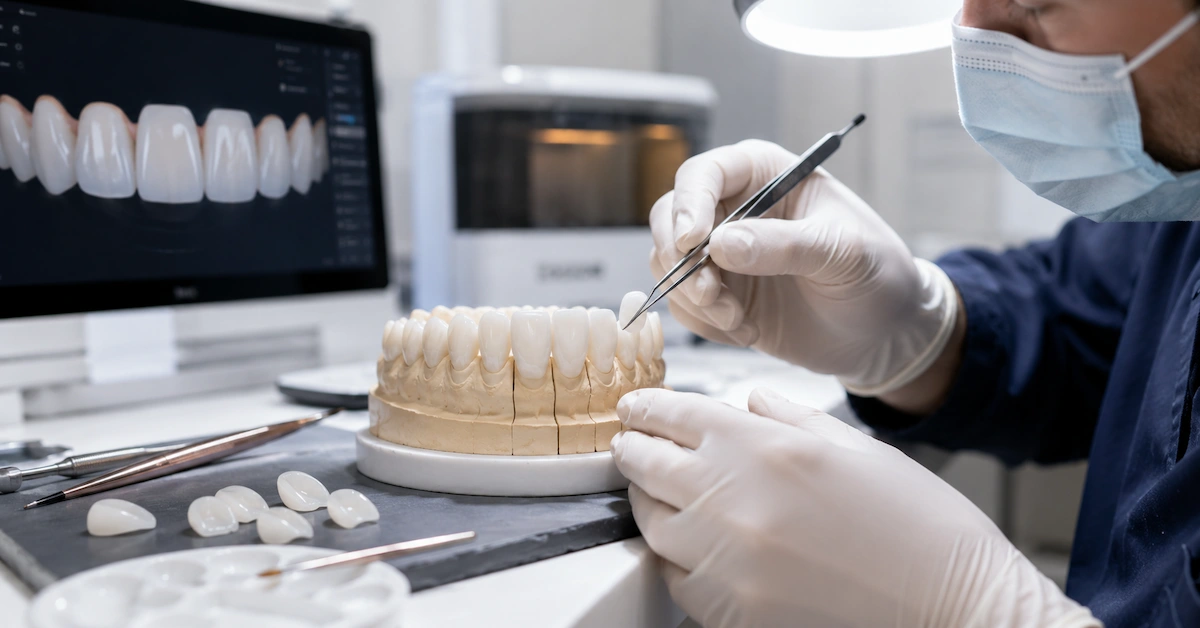

For cosmetic dental clinics, veneers are not simply restorative products. They are part of a complete aesthetic treatment plan that affects smile harmony, facial appearance, and patient confidence.
Among modern ceramic materials, E.max has become widely used because it provides a balance between natural appearance and mechanical performance. Its lithium disilicate ceramic structure allows dental laboratories to create restorations with excellent translucency, strength, and aesthetic customization.
However, achieving predictable veneer results requires more than selecting a high-quality material. It requires:
- Accurate digital impressions
- Professional CAD design
- Shade communication
- Ceramic finishing skills
- Quality control
- Experienced dental technicians
A reliable emax veneer laboratory service helps clinics transform digital scans and clinical requirements into natural-looking veneer restorations.
At Digilabo Dental Laboratory, E.max veneer cases are supported through digital workflows, CAD/CAM design, aesthetic customization, ceramic finishing, QC inspection, and international dental lab services.
What Is an Emax Veneer Laboratory Service?
An emax veneer laboratory service is a professional dental laboratory service focused on designing and fabricating E.max lithium disilicate veneers for cosmetic and restorative cases.
Unlike standard ceramic restorations, veneer cases require advanced aesthetic control.
The laboratory must consider:
- Tooth shape
- Facial harmony
- Smile line
- Incisal translucency
- Surface texture
- Shade matching
- Ceramic thickness
- Margin adaptation
- Patient expectations
A professional E.max veneer lab supports dentists throughout the complete workflow, from digital case review to final restoration delivery.
Why Dental Clinics Choose E.max Veneers
Natural Translucency and Aesthetic Appearance
One of the biggest advantages of E.max veneers is their ability to reproduce the optical characteristics of natural enamel.
Compared with traditional opaque restorations, E.max provides:
- Natural light transmission
- Better depth perception
- Improved translucency
- Realistic enamel-like appearance
- Better integration with surrounding teeth
This makes E.max especially suitable for:
- Anterior veneers
- Smile makeover cases
- Cosmetic rehabilitation
- High-aesthetic restoration zones
For patients, the difference is often visible immediately because the restoration looks more natural rather than artificial.
Strength and Durability of Lithium Disilicate Veneers
Aesthetic appearance is important, but long-term performance is equally critical.
E.max lithium disilicate provides:
- High flexural strength
- Good fracture resistance
- Reliable adhesive bonding performance
- Conservative preparation possibilities
- Stable long-term clinical performance
For dental clinics, this means fewer concerns about:
- Veneer fracture
- Restoration replacement
- Excessive adjustment
- Patient dissatisfaction
The material selection should still depend on clinical indication, preparation design, occlusion, and patient requirements.
E.max Veneer Applications in Modern Dentistry
A professional emax veneer laboratory service should support multiple aesthetic applications.
| Application | Main Benefit | Lab Focus |
|---|---|---|
| Single E.max veneer | Natural tooth matching | Shade and texture customization |
| Multiple veneers | Smile harmony | Tooth proportion and symmetry |
| Smile makeover | Complete aesthetic improvement | Digital smile planning |
| Minimal-prep veneers | Conservative restoration | Ceramic thickness control |
| Anterior crowns | Natural appearance | Translucency and contour |
| Implant crowns | Aesthetic implant restoration | Digital implant workflow |
| Inlays and onlays | Tooth preservation | Precise fit and bonding support |
E.max Veneer Fabrication Workflow
A reliable laboratory should have a structured workflow.
Step 1: Digital Case Submission
Dental clinics provide:
- STL/PLY scan files
- Digital prescription
- Patient photos
- Shade information
- Bite record
- Preparation details
- Smile design requirements
Digital communication allows the laboratory to review the case before production.
Digilabo’s Service and FAQ page explains the digital workflow from case submission and design confirmation to fabrication, QC, and shipping.
Step 2: CAD Design and Aesthetic Planning
The CAD team designs the veneer according to clinical requirements.
Important design considerations include:
- Tooth proportion
- Incisal edge position
- Contact points
- Emergence profile
- Margin design
- Smile symmetry
- Functional requirements
For multiple veneer cases, digital planning helps maintain consistency across the entire smile.
Step 3: E.max Processing and Ceramic Finishing
After design approval, the restoration enters fabrication.
The process may include:
- CAD/CAM processing
- Lithium disilicate preparation
- Ceramic refinement
- Staining
- Glazing
- Surface texture adjustment
- Final polishing
Experienced technicians play an important role in creating natural-looking restorations.
Step 4: Quality Control Before Delivery
Before shipment, Digilabo checks:
- Marginal fit
- Internal adaptation
- Contact points
- Occlusion
- Shade accuracy
- Surface finish
- Final appearance
QC helps clinics receive more predictable restorations and reduce chairside adjustment time.
E.max Veneers vs Zirconia Veneers
| Feature | E.max Veneers | Zirconia Veneers |
| Material | Lithium disilicate ceramic | Zirconium oxide ceramic |
| Aesthetic performance | Excellent translucency | Improved but generally more opaque |
| Strength | High | Very high |
| Best application | Cosmetic anterior cases | High-load cases |
| Natural appearance | Excellent | Good to excellent |
| Main advantage | Beauty and optical properties | Strength and durability |
The best material depends on case requirements. E.max is often preferred when aesthetics are the priority.
How to Choose an Emax Veneer Laboratory Service
Dental clinics should evaluate more than material availability.
1. Digital Workflow Capability
A modern E.max veneer laboratory should support:
- Intraoral scans
- STL files
- Digital prescriptions
- CAD design review
- Digital communication
2. Shade Matching Experience
Successful veneer cases require accurate shade communication.
The lab should understand:
- Shade photos
- Lighting conditions
- Stump shade
- Tooth characterization
- Patient expectations
3. Aesthetic Design Skills
The laboratory should understand:
- Smile design
- Tooth morphology
- Surface texture
- Natural enamel appearance
4. Quality Control System
Before delivery, the lab should check:
- Fit
- Occlusion
- Margins
- Shade
- Surface finish
5. Stable International Support
For overseas clinics, reliable communication and shipping are important factors.
Why Choose Digilabo for Emax Veneer Laboratory Service?
Digilabo provides professional dental laboratory services for global clinics and dental partners.
For E.max veneer cases, Digilabo supports:
- Digital case submission
- CAD/CAM design
- Lithium disilicate veneer fabrication
- Shade matching
- Smile design support
- Ceramic finishing
- QC inspection
- International delivery
With experienced technicians and digital production capabilities, Digilabo helps clinics achieve consistent aesthetic outcomes.
Learn more about Digilabo’s laboratory capabilities through the About Us page.
E.max Veneer Case Submission Checklist
| Information | Purpose |
| STL/PLY scan | Provides accurate digital data |
| Smile photos | Supports aesthetic design |
| Shade photos | Improves color matching |
| Bite record | Controls function |
| Preparation details | Supports margin design |
| Patient expectations | Improves communication |
| Material preference | Guides restoration choice |
| Delivery schedule | Supports appointment planning |
FAQ About Emax Veneer Laboratory Service
1. What is an emax veneer laboratory service?
An emax veneer laboratory service provides professional fabrication of lithium disilicate veneers, including digital design, ceramic processing, finishing, QC, and delivery.
2. Why are E.max veneers popular?
E.max veneers provide a balance of natural aesthetics, translucency, strength, and predictable clinical performance.
3. Are E.max veneers suitable for smile makeover cases?
Yes. E.max veneers are commonly used for aesthetic cases requiring natural appearance and smile improvement.
4. What files should clinics send for E.max veneer cases?
Clinics should provide STL/PLY scans, prescriptions, photos, shade information, and clinical requirements.
5. Does Digilabo provide E.max veneer services?
Yes. Digilabo provides E.max veneer laboratory services including digital workflow, CAD design, ceramic finishing, QC, and international shipping.
6. What is the difference between E.max and zirconia?
E.max focuses on superior aesthetics and translucency, while zirconia generally provides higher strength.
7. How can clinics reduce veneer remake risk?
Complete digital files, accurate shade information, clear communication, and professional lab QC can reduce remake risk.
8. How can clinics work with Digilabo?
Clinics can visit Digilabo Dental Laboratory, explore products on the Products page, or contact the team through the website.
Conclusion
A professional emax veneer laboratory service helps dental clinics achieve more predictable aesthetic restorations through advanced material knowledge, digital workflow, skilled fabrication, and strict quality control.
E.max veneers remain a preferred option for cosmetic dentistry because they combine natural appearance with reliable performance.
Digilabo supports global dental clinics with E.max veneers, digital dental workflows, aesthetic restorations, and complete laboratory services. For clinics seeking a reliable E.max veneer partner, Digilabo provides professional support from case submission to final delivery.