
A useful wax-up must survive the handoff from a CAD screen or physical model to clinical evaluation. This guide shows dental teams how to specify transferable design outputs, check a proposed mock-up, document changes and request a quote that reflects the actual case.
Discuss Your Wax-Up Case → Explore Digital Lab Services ↗Quick answer
A diagnostic wax up laboratory develops a three-dimensional representation of proposed restorative tooth shapes from a clinician's records and prescription. When the clinic wants an intraoral trial smile, the handoff must specify more than an attractive rendering: it must identify the approved geometry, appropriate physical or digital transfer reference, the intended clinical technique, and who checks the result. The laboratory supplies the agreed planning output; the dentist determines whether the design is clinically suitable.
Why mock-up transfer deserves its own laboratory specification
A six- or eight-unit veneer case may look convincing in a frontal CAD image yet communicate too little about how the proposed shape will be reproduced at the chair. The laboratory might send a screen capture while the dentist expects a model suitable for making a silicone index. A second technician might export a different design revision. The clinical team may then evaluate a trial smile that does not correspond to the accepted proposal.
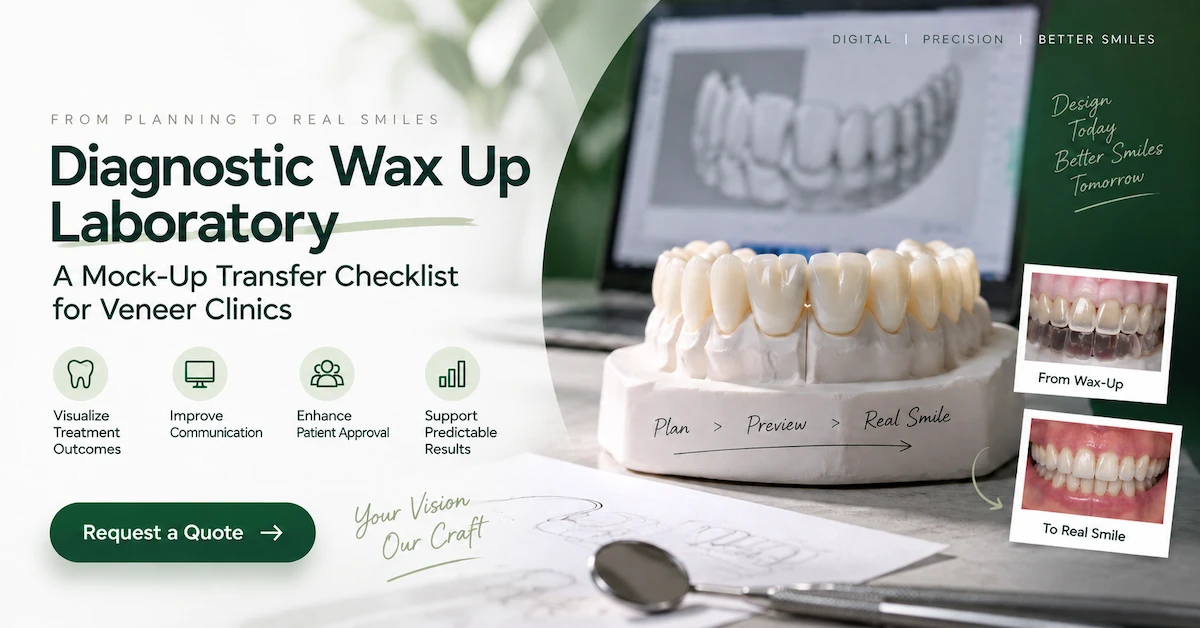
These are handoff problems, not simply cosmetic preferences. A useful transfer workflow connects four different objects: the approved wax-up, the model or transfer reference, the intraoral mock-up, and the later restorative prescription. Each needs a defined purpose and status. A mock-up can help assess proposed contour, length and appearance, but it does not certify ceramic fit or determine that tooth preparation is safe.
In the International Journal of Esthetic Dentistry (2021), Etienne and Nguyen studied indirect mock-up reproducibility. A 2022 clinical case report by Villalobos-Tinoco and colleagues described additive wax-up and an intraoral mock-up before veneer preparation. Both support careful transfer and clinical review, not a universal accuracy guarantee.
What should a diagnostic wax up laboratory deliver for mock-up transfer?
The name diagnostic wax-up does not identify a universal package. The correct purchasing question is, “What exact output will let our clinician evaluate the approved design in the intended setting?” Confirm the options with the laboratory before paying for work or booking the patient.
| Requested output | Purpose | Specify before ordering |
|---|---|---|
| CAD wax-up preview | Remote review of proposed morphology | Views, reference scan, units, approval format and revision number |
| Approved design geometry | Downstream model or restorative planning | File type, arch alignment, ownership, export permission and final version |
| Physical diagnostic model | Tangible approved tooth arrangement | Printed or conventional, arch extent, handling and delivery |
| Transfer index or matrix | Potential transfer reference for a chairside mock-up | Whether the lab actually supplies it, the design and support method, and the clinician's intended technique |
Important: An index, printed model, provisional, and definitive veneer are separate deliverables. None should be assumed to be included in a CAD design price. Digilabo's website lists Diagnostic Wax-Ups within its veneer-related product structure and describes digital design review; clinics should confirm the exact mock-up transfer components currently available. For a broader comparison of service deliverables, see the existing diagnostic wax-up lab service guide.
When is a transferable diagnostic wax-up especially useful?
Consider a documented transfer stage when the planned treatment changes the visible form of several teeth, closes spaces, alters proposed incisal positions, or requires the patient and clinician to evaluate a three-dimensional aesthetic proposal. It can also help with replacing previous restorations when the current contours are a poor reference.
For example, a cosmetic clinic planning eight maxillary anterior veneers may need to compare the proposed incisal display and overall tooth arrangement with the patient's smile during an appointment. A CAD picture starts that discussion; a properly verified clinical mock-up may add information about the appearance and practical behavior of the proposed form.
Do not assume every veneer case needs this process. A single restoration with clearly established anatomy may have a different planning requirement. Worn-dentition, altered occlusal relationships and full-mouth rehabilitation require additional clinical records and decisions that should not be inferred by the technician. The clinician selects the diagnostic method and confirms all treatment decisions.
The six-stage digital-to-chairside handoff
- Clinician sets the objective. Identify treated teeth, proposed aesthetic changes, preparation strategy and any approved occlusal constraints. Do not ask the lab to invent the clinical plan.
- Clinic submits consistent records. Send applicable upper and lower scans, bite, prescription, smile photographs and existing-restoration information under one case identifier.
- Laboratory presents a labeled design. CAD views should distinguish the original anatomy from the proposed changes and show which version is under review.
- Clinician approves the morphology. Record accepted teeth and any unresolved points; approval of appearance is not approval of restorative material or final ceramic fit.
- Transfer output is prepared where contracted. Confirm that the physical model or matrix corresponds to the approved CAD geometry, is usable with the intended clinical technique, and passes the agreed checks.
- Clinic verifies the trial and feeds back changes. Document any modifications made during clinical evaluation, and decide whether revised laboratory geometry is required before proceeding.
Digilabo's published digital laboratory workflow describes scan or prescription submission, CAD design review and manufacturing. The six stages above are a practical clinic-to-lab specification, not a claim that every step or transfer component is included in its standard wax-up service.
12-point mock-up transfer acceptance checklist
This checklist gives the dentist and laboratory a shared language for deciding whether a transfer package is ready, requires clarification, or needs revision. It is an operational template rather than a clinical standard or manufacturer-specific tolerance specification.
| No. | Acceptance check | Practical evidence or decision |
|---|---|---|
| 01 | Case identity | Correct de-identified case ID, treating practice and tooth numbering system |
| 02 | Record alignment | Upper and lower anatomy, bite relation and scan version agree |
| 03 | Restoration units | Exact teeth to be altered are labeled; adjacent teeth remain identifiable |
| 04 | Anterior reference | Midline, proposed tooth length and incisal positions reviewed by dentist |
| 05 | Tooth form | Facial contour, line angles, embrasures and contact areas match the brief |
| 06 | Clinical constraints | Any prescribed restorative-space or occlusal restrictions are represented |
| 07 | Approved design | Written approval names a unique CAD version and date |
| 08 | Model geometry | Physical or exported model matches that approved version, if supplied |
| 09 | Transfer support | The index or matrix, if ordered, has an identified seating reference and method |
| 10 | Material/method | Clinician has confirmed intended mock-up material and clinical technique |
| 11 | Package contents | Model, file, preview and instructions match the written quotation |
| 12 | Clinical feedback route | Named contact, revision procedure and next-approval step documented |
For each line, mark Accepted / Clarify / Revise / Not applicable. An unresolved bite discrepancy or uncertain design version should stop the handoff; a cosmetic preference that needs a minor change can be returned as a precise CAD comment. Do not turn the checklist into an invented claim that every case meets a fixed micrometer threshold.
Planning an anterior veneer case?
Send the tooth numbers, intended mock-up method and available scan records. Ask for a quotation showing the design, revision and transfer outputs separately.
Request a Case-Specific Quote →What should dentists send to a diagnostic wax up laboratory?
Good CAD software cannot reconstruct an uncommunicated aesthetic objective. Even a well-scanned arch only describes what currently exists. A complete lab brief should explain what the clinician wants to change and what must be preserved. Use the following list as an intake guide; not every item applies to every case.
| Record | What the lab needs to know |
|---|---|
| Prescription & unit list | Numbering system, teeth involved, treatment objective and intended restorative route |
| Digital scans or impressions | Upper/lower arches and acceptable STL/PLY or physical records, as confirmed |
| Occlusal record | Relevant jaw relationship; any altered position must come from the clinician |
| Photographs | Smile, retracted anterior and contextual views where needed for aesthetic planning |
| Design objectives | Desired incisal length, spacing, shape, symmetry and features to retain |
| Transfer requirement | Digital preview only, model, index discussion or a specific mock-up reference |
| Commercial schedule | Date needed for design review, clinical trial and any physical shipment |
| Privacy controls | Use permitted secure submission channels and only the patient data necessary |
For restoration replacements, identify which existing contours to retain. For additive veneers, state the intended additions and clinical constraints; the dentist determines biological and restorative feasibility.
Silicone index, printed model or CAD-only transfer: which route fits the case?
A silicone index can be created from a physical diagnostic model to assist an intraoral trial using a clinician-selected temporary material. Its quality depends on the reference model, seating stability, index design and technique. An index that lacks clear support on unchanged anatomy may be difficult to position consistently. The exact material and chairside procedure should be chosen by the dentist.
A digitally printed diagnostic model may reproduce approved CAD morphology and serve as a reference for certain index-making workflows. However, print orientation, material processing, model handling and downstream matrix production can introduce discrepancies. Ask the supplying lab what physical output it has validated and what is included in its service.
A CAD-only delivery is useful when the purchasing practice or local partner can manufacture the required physical components. This avoids assuming that a remote design laboratory must also ship a transfer index. Confirm export format, shared coordinate orientation and whether the receiving equipment can use the file without reinterpretation.
Scientific literature describes multiple workable techniques rather than one universally superior transfer route. The 2021 Etienne–Nguyen study examined reproducibility of two indirect mock-up approaches; its measured results should not be represented as a guarantee for a different model, material or operator. Select the route according to the actual clinical and manufacturing system.
Common mock-up transfer failures and how to prevent them
| Warning sign | Potential cause | Required response |
|---|---|---|
| The index does not seat consistently | Insufficient support, deformation or changed anatomy | Pause and assess fit and the reference model; do not force transfer |
| Mock-up teeth differ from approved CAD | Wrong version, manufacturing or transfer discrepancy | Compare dated design and physical output before revising |
| Incisal display surprises the patient | Incomplete facial references or different clinical appearance | Document actual feedback; clinician decides whether to redesign |
| Opposing contact seems inconsistent | Bite record mismatch or an unapproved design constraint | Clinician verifies records before any downstream fabrication |
| An unexpected additional charge appears | Index, physical model or major redesign excluded from quote | Request line-item scope and revision authorization |
| Final veneer expectations drift | Clinical trial changes not returned to the CAD team | Record accepted changes and start a revised restorative design |
Version control: do not let an approved trial become the wrong final design
A strong workflow preserves the identity of the approved design. Consider a clinic that accepts version V2 for a six-unit case. During a trial visit, the dentist and patient prefer slightly shorter lateral incisors. If the clinic simply writes “make these shorter” without identifying V2 and the teeth concerned, the technician may apply the instruction to V1 or to a model already in production.
A better record names the case ID, source scan date, design version, specific teeth, requested change, approver and new status. For example: “Case A184 / design V2 / shorten proposed lateral incisor edges as marked in the attached clinical review / revised CAD required before manufacturing.” Use de-identified references and an approved secure communications channel.
After a clinical mock-up, the dentist should issue one of three decisions: accept the proposed morphology, request a defined revision, or suspend the design pending additional records. If the treatment plan changes substantially, withdraw the old approval explicitly. Do not equate consent to a visual trial with approval of ceramic thickness, tooth reduction, shade, cementation or final prosthetic fit.
With an overseas partner, confirm design ownership, file export, retention, authorized access and whether the definitive-restoration laboratory can use the approved geometry.
What should a diagnostic wax up laboratory quote include?
For a clinic ordering transfer-ready planning work, a per-tooth price alone may conceal the most important cost differences. Ask the laboratory to itemize design, review, revisions, physical outputs, shipping and downstream coordination. A digital-only quote should not be compared directly with a quote that includes a printed model and an index.
- Case scope: number of teeth, single or both arches, and any unusual clinical constraints.
- Included deliverables: preview, exportable geometry, model, matrix or other items actually available.
- Revision rules: number and type of included changes; treatment-plan changes priced separately.
- Milestones: intake clarification, first design, clinical approval, physical dispatch and estimated transit.
- Responsibilities: design sign-off, transfer technique, clinical evaluation and later restorative prescription.
- Data governance: permitted upload channel, access, retention and confidentiality.
An urgent appointment should be expressed as a clinic arrival deadline, not simply a request for rapid CAD turnaround. Production and shipping are separate activities. Digilabo describes international laboratory services, but diagnostic wax-up model availability, case-specific timing, revision charges and freight must be confirmed for the proposed order.
How Digilabo fits into a wax-up-to-restoration workflow
On aspendentallabs.com, the laboratory presents its services under the Digilabo Dental Laboratory name. Its published capabilities include digital scan intake, CAD design review, aesthetic restorative work and fabrication of veneers and crowns. Diagnostic Wax-Ups are listed within the website's veneer-related product categories. You can review the veneer product family, crown and bridge category, and laboratory profile before sending an inquiry.
These published pages establish a relevant starting point for professional case discussions; they do not independently confirm that any requested silicone index, physical wax-up, validated mock-up kit, export file or turnaround is currently included. For an accurate quotation, tell the team whether you need a CAD design for approval only, a physical transfer reference, or coordination with definitive veneer or crown fabrication. Ask which outputs the team can provide for your actual records.
Request a useful technical quotation—not just a price per tooth.
Tell us your clinic type, treatment region, intended mock-up transfer route and required deliverables. Ask Digilabo to confirm feasible options, approvals, revisions and timing before you schedule the case.
Contact Digilabo for Case Review → Browse Dental Products ↗Diagnostic Wax Up Laboratory RFQ: A copy-ready clinic brief
Subject: Diagnostic Wax-Up and Mock-Up Transfer Inquiry
We are a [clinic / prosthodontic practice / dental laboratory] planning a [number]-unit [anterior veneer / restorative] case. Our objective is [proposed morphology and clinical purpose]. We have [STL/PLY scans, bite records, clinical photos] available and need [CAD preview / approved export / physical model / transfer index, if offered]. Please confirm accepted records, available transfer outputs, design approval procedure, included revisions, itemized pricing, data-handling method and the estimated dates for initial CAD review and any physical delivery. Our desired clinical review date is [date].
For recurring orders, standardize the prescription and approval template while retaining patient-specific clinical instructions.
Frequently Asked Questions
1. What is the difference between a diagnostic wax-up and a clinical mock-up?
A diagnostic wax-up is a proposed three-dimensional tooth arrangement, created digitally or on a physical model. A clinical mock-up is an intraoral simulation used by the treating dentist to evaluate an intended form. A wax-up can inform a mock-up, but a digital rendering is not itself an intraoral trial.
2. Can a diagnostic wax up laboratory work from STL or PLY scans?
Many CAD-based laboratories work with these formats. Digilabo's general digital workflow lists STL/PLY submission. The clinic should still confirm file compatibility for the requested wax-up, whether bite and opposing scans are needed, and which additional photos and clinical instructions should accompany the files.
3. Does ordering a digital wax-up include a silicone index?
Not necessarily. Digital design, physical model production and index fabrication are different outputs. Confirm whether the chosen laboratory offers the relevant index, the intended support method, pricing, production schedule and shipping details. Do not infer this from a product-category label alone.
4. What should be checked before using a transferred mock-up?
The treating dentist should check the correct case and approved version, transfer seating, morphology, planned aesthetic references and case-specific clinical constraints. Any discrepancy requiring clinical judgment must be resolved by the clinician before the mock-up is relied upon for subsequent treatment decisions.
5. Does an approved mock-up guarantee the final veneers will fit?
No. A mock-up primarily supports evaluation of a proposed design. Definitive restorations require appropriate tooth-preparation records, margin definition, material selection, laboratory checks and clinical assessment. The final result may differ when the treatment plan or anatomy changes.
6. How much does diagnostic wax-up and mock-up transfer cost?
The quotation depends on unit count, complexity, design revisions, whether a physical model or index is provided, and delivery requirements. Request a line-item quote rather than assuming a universal laboratory fee. Clinics can submit their requested outputs through the contact page.
7. Should the same laboratory make the wax-up and final restorations?
It can simplify coordination when the provider actually offers both services and maintains the approved design reference. It is not mandatory. When different laboratories are involved, the clinic should confirm file portability, handoff responsibilities, revision history and the definitive restoration prescription.
Conclusion
A diagnostic wax up laboratory is most valuable when it delivers a clearly specified design that the clinical team can review and, where appropriate, transfer into a controlled mock-up workflow. For veneer clinics, the essentials are complete records, an identifiable approved CAD version, a suitable transfer reference, explicit clinical verification and documented revisions. Before ordering, confirm the exact digital or physical outputs and the commercial terms. Contact Digilabo Dental Laboratory with your case brief to discuss available wax-up support and request a tailored quotation.