
Diagnostic Wax Up Outsourcing: How to Transfer Cases Without Losing Clinical Control
Diagnostic wax up outsourcing can help dental clinics, prosthodontists, cosmetic dentists, and dental laboratories obtain external diagnostic design support without maintaining every technician, CAD workstation, and model-production capability internally.
The challenge is not simply finding someone who can produce a wax-up.
The real challenge is transferring a clinical treatment objective to an external laboratory without losing the information that makes the design useful.
A dentist may request changes to anterior tooth proportions, incisal edge position, arch relationships, or restorative contours. The laboratory then needs to interpret those instructions using digital scans, bite records, photographs, and relevant clinical information.
If any part of that exchange is unclear, the design may require unnecessary revisions or fail to serve its intended purpose.
The central rule of successful diagnostic wax up outsourcing is simple: outsource the design work, not the clinical decisions.
The treating dentist remains responsible for diagnosis, treatment planning, clinical feasibility, and final approval. The external laboratory converts the approved requirements into an agreed diagnostic deliverable.
For a cosmetic clinic, that deliverable may be a digital wax-up for an anterior veneer case. For a prosthodontic practice, it may support a more complex restorative plan. For another dental laboratory, it may be an outsourced CAD design that will eventually be integrated into its own production workflow.
These buyers have different technical and commercial needs.
A useful outsourcing system must therefore answer several questions before the first order is placed:
-
Which cases are suitable for outsourcing?
-
What files and clinical instructions must be submitted?
-
Who reviews incomplete or inconsistent records?
-
What exactly is included in the laboratory's quotation?
-
How will CAD designs be reviewed and approved?
-
What constitutes an acceptable final deliverable?
-
How are revisions, delays, and additional charges handled?
-
Who owns the files and manages patient-data access?
-
Can the approved design support later restorative work?
-
How should the clinic evaluate the supplier after a trial case?
This article provides a practical framework for answering those questions.
Digilabo Dental Laboratory offers digital dental laboratory workflows and lists diagnostic wax-ups within its veneer-related product categories. Its broader laboratory services include digital case submission, CAD design review, restorative production, quality control, and international case coordination.
For clinics considering outsourced diagnostic planning, the objective should be a workflow that preserves accuracy, accountability, and clinical control—not simply the lowest design fee.
What Is Diagnostic Wax Up Outsourcing?
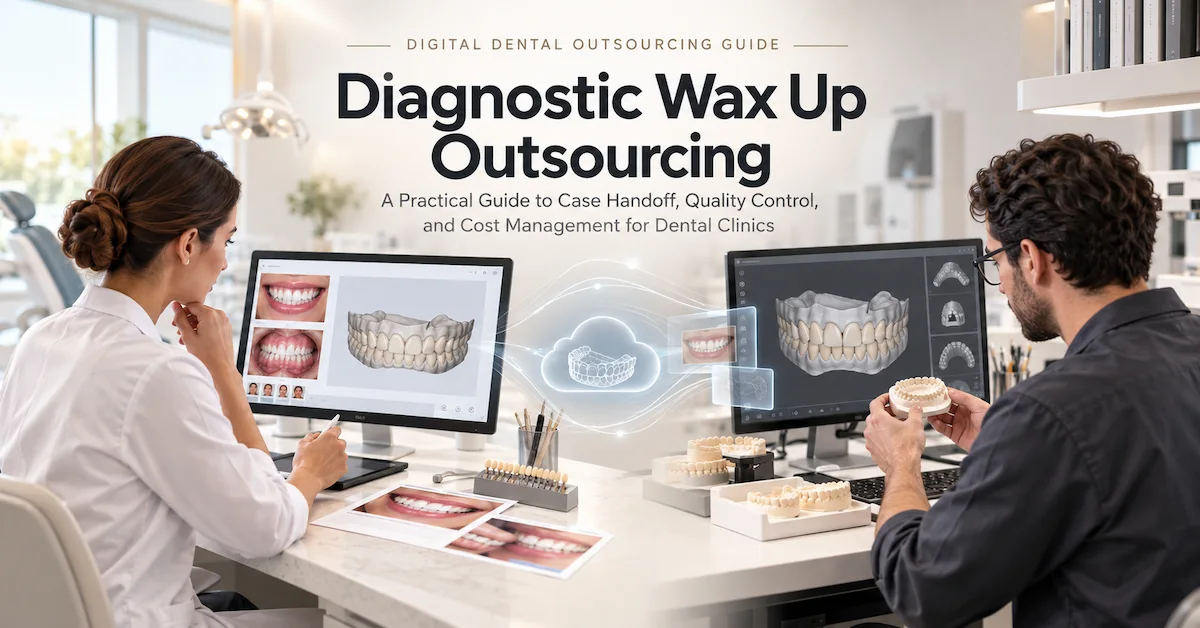
Diagnostic wax up outsourcing is the process of assigning some or all diagnostic wax-up design or model-production work to an external dental laboratory.
The clinic provides the relevant records and clinical instructions. The laboratory creates the agreed planning output, submits it for review where required, incorporates authorized changes, and delivers the approved files or physical components.
The service can include several different outputs.
Digital Diagnostic Wax-Up
A CAD-based three-dimensional design showing proposed tooth morphology.
It may be used to evaluate tooth proportions, contours, arrangement, and other prescribed changes before definitive restorative treatment.
Conventional Diagnostic Wax-Up
A physical wax modification created on a diagnostic model.
This may be useful when the clinical workflow requires a tangible reference or conventional model-based transfer.
Printed Diagnostic Model
A physical model manufactured from an approved digital design, depending on the laboratory's equipment and available service options.
Mock-Up or Provisional Reference
The proposed design may provide information for a subsequent clinical mock-up, silicone index, or provisional restoration workflow.
These outputs should not be treated as interchangeable.
A digital rendering is not automatically a printable model. A printable model is not necessarily a clinical mock-up. An approved wax-up is not the same as a definitive restoration.
Before outsourcing, the buyer must specify the actual deliverable and its intended use.
When Should Dental Clinics Outsource Diagnostic Wax-Up Work?
Outsourcing is most useful when external laboratory resources solve a specific technical or operational problem.
Common situations include limited internal CAD capacity, irregular demand, complex aesthetic cases, and the need to coordinate planning with later restorative fabrication.
1. The Clinic Does Not Have an In-House CAD Technician
Many dental clinics have intraoral scanners but do not maintain a dedicated dental CAD design department.
The scanner captures digital records. It does not independently establish a complete restorative design.
External CAD support may help the clinic translate those records into an agreed diagnostic planning output.
This can be particularly relevant for practices that regularly perform veneer cases but have insufficient volume to justify a full-time diagnostic designer.
2. Diagnostic Case Volume Fluctuates
A clinic may handle several smile makeover cases one month and relatively few the next.
Hiring permanent technical staff for fluctuating demand can be difficult to justify.
Outsourcing allows the practice to purchase services according to actual case requirements.
However, the supplier's available capacity and delivery schedule should still be confirmed.
3. The Practice Handles Complex Aesthetic Restorations
Multi-unit anterior cases may require more detailed design coordination than routine single-unit restorations.
A specialized dental laboratory can contribute technical design resources while the treating dentist controls the clinical objectives.
4. The Clinic Wants Planning and Restorative Production Coordinated
Some practices prefer to use the same laboratory for diagnostic planning and later veneer or crown fabrication.
This may simplify communication and help preserve the approved design reference.
The laboratory must still reassess definitive records, preparation geometry, materials, and other manufacturing requirements.
5. Another Dental Laboratory Needs Overflow CAD Capacity
Not every outsourcing buyer is a dental clinic.
Independent laboratories may outsource diagnostic designs when:
-
Technician availability is limited
-
Case volume temporarily increases
-
A client requests additional planning outputs
-
Existing workstations are at capacity
-
A specialized aesthetic design is needed
The outsourcing laboratory must establish who communicates with the end customer and who controls the approved design.
When Outsourcing May Not Be Appropriate
External processing is not automatically the best option.
A case may be better handled locally or in-house when repeated immediate clinical verification is required, essential records cannot be transferred securely, or the necessary communication infrastructure is unavailable.
Complex cases requiring extensive chairside adjustment or interdisciplinary clinical decisions may also need additional local review stages.
The decision should be driven by the case and available resources rather than by the assumption that outsourcing is always cheaper.
In-House vs Outsourced Diagnostic Wax-Up: A Buyer Comparison
The decision between internal and external production should consider total workflow requirements.
| Evaluation Factor | In-House Diagnostic Design | Outsourced Diagnostic Design |
|---|---|---|
| Initial technical investment | CAD software, equipment, training, staff | Usually purchased as a service |
| Technician availability | Depends on internal staffing | Depends on supplier capacity |
| Case communication | Direct internal communication | Requires structured digital handoff |
| Design revisions | Managed internally | Subject to agreed revision process |
| Software maintenance | Clinic or laboratory responsibility | Normally managed by the service provider |
| Physical model production | Requires appropriate equipment | Must be included or ordered separately |
| Data transfer | Primarily internal | Requires external information-sharing controls |
| Scalability | Limited by local resources | Can expand if supplier capacity supports demand |
| Quality control | Internal technical and clinical review | Shared process with defined responsibilities |
| Best fit | Frequent cases with established internal capability | Variable demand, external expertise, overflow production |
Neither approach guarantees better clinical outcomes.
A clinic with an experienced in-house technician and an established protocol may have an efficient internal workflow.
An external laboratory may be attractive when the clinic wants to reduce technical investment or obtain access to specialized resources.
The correct comparison is total case cost, technical suitability, and workflow reliability—not simply the advertised design price.
Define Exactly What You Are Outsourcing
Before contacting a diagnostic wax-up laboratory, prepare a written scope of work.
This is one of the most effective ways to prevent unexpected costs and disagreements.
A scope of work should identify the service being purchased, the supplied records, the required outputs, and the approval responsibilities.
Design-Only Outsourcing
The external laboratory develops a digital wax-up and supplies an agreed review file or other specified CAD output.
The clinic or another laboratory handles downstream physical production.
This arrangement may suit dental laboratories with existing printing or restorative manufacturing capabilities.
Design and Physical Model Outsourcing
The supplier prepares the digital design and manufactures a corresponding diagnostic model.
The quotation should identify the model material, production method, shipping arrangement, and whether revisions require new physical production.
Planning-to-Restoration Workflow
The laboratory supports the diagnostic planning stage and may subsequently manufacture veneers, crowns, or other prescribed restorations.
This arrangement requires clear separation between planning approval and final restorative production approval.
A Practical Scope-of-Work Table
| Item | What the Buyer Should Specify |
|---|---|
| Case identification | Unique case number and authorized clinic reference |
| Teeth involved | Exact tooth numbers and arches |
| Clinical objective | Proposed restorative changes |
| Source records | Scans, bite, photographs, and prescription |
| Design type | Digital or conventional wax-up |
| Design review | Preview format and approval method |
| Revision scope | Included changes and additional charges |
| Final output | Agreed digital files, physical model, or other deliverables |
| Delivery milestone | Preview, approval file, dispatch, or clinic arrival |
| Data handling | Transfer, access, retention, and deletion requirements |
| Downstream use | Mock-up, provisional, veneer, crown, or other reference |
| Commercial terms | Fees, payment, shipping, and change-order rules |
A laboratory does not need to offer every possible service.
It does need to confirm which services are actually included.
Clinical Responsibility vs Laboratory Responsibility
A common outsourcing mistake is allowing responsibility for important decisions to become unclear.
The dentist may assume that the technician has evaluated clinical feasibility.
The technician may assume that the dentist has already approved every functional and anatomical requirement.
Neither assumption is a reliable substitute for documented instructions.
Recommended Responsibility Matrix
| Activity | Treating Dentist or Clinical Team | External Dental Laboratory |
|---|---|---|
| Clinical examination and diagnosis | Responsible | Not responsible |
| Treatment objectives | Defines and approves | Receives and clarifies |
| Patient consent | Responsible | Not responsible |
| Scan capture | Performs or arranges | Reviews submitted data for technical usability |
| Bite registration | Determines and records | Uses the approved record |
| Material prescription | Determines clinically | Discusses technical options within scope |
| CAD wax-up creation | Supplies instructions | Performs agreed design work |
| Design revision request | Reviews and authorizes | Implements agreed changes |
| Clinical feasibility assessment | Responsible | Flags apparent technical conflicts |
| Diagnostic design approval | Responsible | Records approved version |
| Physical model production | Orders and verifies | Manufactures if included |
| Definitive restoration approval | Responsible | Produces according to approved specifications |
A laboratory can help identify technical concerns, but it should not independently diagnose the patient or determine treatment.
For example, the decision to change vertical dimension of occlusion must originate from the clinician's treatment plan.
The laboratory may then design according to that prescribed relationship.
This distinction is especially important in full-mouth rehabilitation and cases involving extensive wear.
What Case Files Are Required for Dental Wax-Up Outsourcing?
The quality of the final design depends on the quality and completeness of the submitted information.
A scan alone does not communicate every clinical objective.
The submission should combine reliable digital geometry with clear treatment instructions.
Upper and Lower Arch Scans
Where a digital workflow is used, complete arch information may be needed to understand existing tooth morphology, neighboring structures, and interarch relationships.
The laboratory may accept STL, PLY, or other supported files.
The buyer should verify compatibility before sending the first case.
Bite Records
The bite information should correspond to the clinical relationship intended for design.
Incomplete or inconsistent interarch data can make the proposed morphology unreliable.
For cases involving a planned change in occlusal relationship, the dentist must provide the relevant approved records.
Clinical Photographs
For cosmetic dental wax up outsourcing, photographs are often essential to communicate aesthetic objectives.
Useful records may include:
-
Full-face smile photographs
-
Natural smile photographs
-
Retracted anterior photographs
-
Right and left intraoral views
-
Occlusal photographs
-
Relevant facial references
The clinic should explain which photographs are intended to guide the design.
Treatment Prescription
The prescription should specify:
-
Tooth numbers
-
Planned restoration types
-
Desired morphological changes
-
Existing restorations
-
Preparation strategy
-
Occlusal considerations
-
Relevant clinical limitations
-
Intended diagnostic output
Vague instructions such as "make the teeth look natural" are insufficient for a complex aesthetic case.
A more useful request identifies the exact changes that the dentist wants the laboratory to evaluate.
Aesthetic Reference Information
Where appropriate, provide desired tooth-form references, information about incisal length, symmetry, midline, arch appearance, or other treatment-specific objectives.
These references should support the dentist's clinical plan rather than replace it.
Delivery Requirements
The clinic should state whether it requires:
-
Initial CAD preview
-
Approved digital design
-
Exportable CAD file
-
Printed model
-
Physical wax-up
-
A reference for a clinical mock-up
-
Additional laboratory production
Not every design package includes all these outputs.
Digital Case Submission: A Step-by-Step Outsourcing SOP
A standardized operating procedure helps clinics manage recurring outsourced cases without repeatedly resolving the same questions.
The following workflow can be adapted to the clinic's circumstances and the laboratory's confirmed capabilities.
Step 1: Create a Unique Case Record
Assign an internal case identifier before sending files.
The identifier should be consistent across the prescription, scan files, photographs, and correspondence.
Avoid using a patient's full name as the primary external identifier when a less identifying reference is sufficient.
Step 2: Confirm the Clinical Objective
The clinician documents why the wax-up is required.
For example, the purpose might be to assess proposed six-unit anterior veneer morphology before definitive preparation.
The laboratory should understand the intended use of the design.
Step 3: Export the Required Digital Records
Export the supported scan files, bite information, and relevant photographs.
Check that all required data corresponds to the correct case.
Step 4: Perform an Internal Submission Check
Before transfer, confirm that the intended arches, tooth numbers, prescription, and design references are complete.
The clinic should resolve known scan or record problems before outsourcing whenever possible.
Step 5: Transfer Files Through an Agreed Channel
Use the communication or file-transfer method agreed with the laboratory.
Confirm the case identifier and whether the supplier has successfully received the complete submission.
Step 6: Obtain Technical Intake Confirmation
The laboratory reviews the records and identifies missing or inconsistent information.
This stage should occur before the supplier commits to final design production.
Step 7: Produce the Initial Diagnostic Design
The technician develops the proposed morphology according to the approved prescription.
The laboratory may use CAD tools for tooth-shape design, digital model evaluation, and virtual review.
Step 8: Review and Request Revisions
The clinic evaluates the initial design.
Feedback should refer to specific teeth, surfaces, contours, or design objectives rather than general statements.
Step 9: Approve the Correct Design Version
Once the dentist is satisfied that the design serves the prescribed purpose, record the approved version.
An approval should never be confused with authorization for unrelated clinical or manufacturing changes.
Step 10: Deliver the Agreed Outputs
The supplier provides the files, models, or other agreed components.
The clinic checks that the correct approved version has been delivered.
Step 11: Close and Archive the Case
Record relevant delivery details, approvals, and any outstanding limitations.
Digital archiving should follow the agreed data-retention and confidentiality policy.
This process is particularly useful for clinics managing several outsourced cases simultaneously.
Technical Quality Control Before Approving an Outsourced Wax-Up
A diagnostic design should not be accepted only because it looks attractive on a screen.
Technical review must consider the original clinical objective and whether the supplied files support the intended output.
1. Case and File Identity
Confirm that the correct patient or authorized case reference and the latest clinical records were used.
Using an outdated scan can invalidate otherwise careful design work.
2. Tooth Numbers and Restoration Scope
Verify that the design addresses the correct teeth.
This seems basic, but incorrect numbering or unclear case instructions can create avoidable processing problems.
3. Incisal Edge Position
Review the proposed incisal position against the prescribed aesthetic and functional goals.
Small changes can influence visible tooth proportions and require clinical assessment.
4. Tooth Width and Length
Assess the proposed morphology in relation to adjacent teeth, overall arch form, and the dentist's objectives.
Numerical proportions can serve as references, but they should not be applied as universal rules.
5. Facial Contour
Excessively bulky proposed restorations may conflict with the intended restorative approach.
The clinic should review facial contours and available restorative space.
6. Embrasures and Interproximal Form
The design should account for the relationships between neighboring teeth.
An aesthetic wax-up should not be treated as a collection of unrelated individual crowns.
7. Occlusal Relationships
Where relevant, the laboratory should evaluate the supplied interarch data.
However, virtual contact visualization cannot substitute for clinical verification.
8. Design Version
Confirm that the reviewed file is the same version that the supplier intends to deliver or use for the next stage.
9. Deliverable Integrity
If a digital file is required, confirm that it can be opened and used for the agreed purpose.
If a physical model is required, its condition and correspondence to the approved design should be checked upon receipt.
10. Clinical Approval
The treating dentist should confirm acceptance for the specified planning purpose.
Quality control is complete only when the design, records, output, and approval refer to the same case and version.
Digital Wax-Up vs Conventional Wax-Up for Outsourced Cases
Digital production can simplify electronic communication, but the preferred method depends on the clinical and laboratory workflow.
| Factor | Digital Wax-Up Outsourcing | Conventional Wax-Up Outsourcing |
|---|---|---|
| Starting records | Digital scans or scanned physical models | Physical impressions or models |
| Design method | CAD-based morphology development | Manual wax application |
| Remote review | Digital previews and file exchange | Photographs, digitization, or physical delivery |
| Revision handling | Digital modifications | Physical modification or remake |
| Design archiving | Digital file storage | Physical or digitized archive |
| Physical output | Manufactured if required | Physical wax-up inherently produced |
| International cooperation | Electronic transfer can reduce initial shipping | Physical logistics may be necessary |
| Main consideration | Data quality and digital handoff control | Model accuracy and physical handling |
Digital is not automatically clinically superior in every situation.
A 2023 pilot study by Chisnoiu and colleagues, published in the Journal of Personalized Medicine, compared conventional and digital approaches to smile design and mock-ups. The small study found broadly similar aesthetic assessments, illustrating the need to evaluate both methods according to the case rather than assuming one is universally better.
The study was limited in size and should not be interpreted as proof of equivalent outcomes for all restorative treatments.
A broader 2024 scoping review by Joda and colleagues in Clinical Oral Implants Research also documented the role of digital applications, including virtual treatment simulation and wax-up techniques, in prosthodontic diagnostic planning.
The practical outsourcing conclusion is straightforward: select a workflow based on the clinical requirements, available records, review method, and intended final output.
How Much Does Diagnostic Wax Up Outsourcing Cost?
There is no single reliable market price for every diagnostic wax-up case.
The total cost depends on what is being designed and delivered.
A simple digital anterior planning design should not be priced as though it requires the same technical effort as a complex full-mouth rehabilitation.
Main Pricing Factors
Common factors include:
-
Number of teeth
-
Single-arch or multi-arch scope
-
Digital or conventional workflow
-
Complexity of planned morphological changes
-
Occlusal planning requirements
-
Physical model requirements
-
Number of included revisions
-
Additional design outputs
-
Priority processing
-
Shipping and customs costs, where applicable
When comparing quotations, request a breakdown rather than a single unexplained figure.
The True Cost of Outsourcing
A practical cost comparison can use the following framework:
Total Outsourcing Cost = Design Fee + Additional Revisions + Physical Outputs + Shipping + Internal Coordination + Delay-Related Costs
Not every case will incur every cost.
The formula is intended to help buyers understand the total purchasing decision.
For example, a lower-priced supplier may require additional charges for every revision or physical model.
A higher-priced supplier may include a broader agreed scope.
Without comparing identical deliverables, the quotations are not directly comparable.
Is Outsourcing Cheaper Than In-House Production?
It depends on the clinic's actual volume and resources.
An in-house workflow may involve:
-
CAD software licensing
-
Workstation investment
-
Technician salaries
-
Training
-
Maintenance
-
Printing equipment
-
Material costs
-
Management time
Outsourcing converts some of those internal expenses into service-based purchasing costs.
However, external communication, revision handling, and data management create their own workload.
The better option should be determined through a comparison of expected cases, internal costs, available expertise, and supplier quotations.
How to Prevent Hidden Costs in Dental CAD Design Outsourcing
Hidden costs are not always caused by dishonest pricing.
They often result from an incomplete agreement about the work.
A laboratory may quote for digital design only while the buyer assumes the price includes physical models, unlimited revisions, or downstream restoration production.
These misunderstandings can be avoided.
Before confirming an order, ask:
-
Does the quotation include the initial design?
-
How many revisions are included?
-
What counts as a major redesign?
-
Is a printable model file included?
-
Is physical model production included?
-
Who pays shipping?
-
What happens when the dentist changes the prescription?
-
Are additional outputs charged separately?
-
What is the payment schedule?
-
What happens if the deliverable differs from the agreed specification?
These questions should be answered in writing.
A clear agreement helps both sides distinguish between correcting a supplier error and requesting a new design objective.
How to Manage Revisions Without Delaying Treatment
Revisions are a normal part of diagnostic design.
The problem is not that revisions occur.
The problem is when neither side knows why they occurred, which file should be changed, or whether they affect the original quotation.
A useful revision process includes three elements.
Specific Feedback
Instead of writing:
"The design does not look right."
Provide a measurable instruction where possible:
"Maintain the central incisor length from Version 01, reduce the proposed facial prominence of the lateral incisors, and preserve the previously approved midline."
Specific feedback makes it easier to identify the requested changes.
Version Identification
Use consistent version numbers or timestamps.
For example:
-
DW-104-V01 — Initial proposal
-
DW-104-V02 — Revised anterior contours
-
DW-104-V03 — Approved planning design
The identifiers are illustrative, not a required Digilabo numbering system.
Change Classification
Distinguish between:
Correction: The delivered design does not follow an agreed instruction.
Minor revision: The dentist requests an adjustment within the existing scope.
Major redesign: The dentist changes the treatment objective, provides substantially different records, or expands the tooth coverage.
The commercial terms should explain how each situation is handled.
This approach reduces disputes and improves turnaround planning.
Lead Time and Delivery: What Should Clinics Confirm?
A supplier's advertised turnaround time may not describe the complete period between submission and clinic use.
Several separate milestones may exist:
Submission → Intake Acceptance → Initial Design → Clinical Review → Revision → Final Approval → Physical Production → Shipping → Clinic Arrival
The schedule for a digital file-only order may differ significantly from a case involving a physical model and international delivery.
A clinic should therefore request milestone-based estimates.
Initial Design Lead Time
The period required for the laboratory to prepare the first reviewable design after accepting complete records.
Revision Lead Time
The expected time for modifications after receiving clear, authorized feedback.
Final File Delivery
The point at which the laboratory provides the agreed approved design files.
Physical Production Time
Additional time if a diagnostic model or other physical item must be manufactured.
International Shipping Time
Transit and potential customs processing for physical items.
International shipping schedules may be affected by location, shipment type, and external circumstances.
A production deadline is not the same as a guaranteed clinic arrival date.
For appointment-dependent cases, the dentist should leave time for review, possible revisions, and clinical evaluation.
Protecting Patient Data During International Outsourcing
Dental scan files and photographs can contain sensitive patient information.
Even when an STL file does not visibly contain a patient's full name, the associated case records may still be identifiable.
Before sending information to an overseas laboratory, clinics should determine which data is necessary and which privacy obligations apply.
Important questions include:
-
Does the laboratory need the patient's full name?
-
Can a unique case identifier be used instead?
-
How are scans and photographs transferred?
-
Who can access the files?
-
Is subcontracting permitted?
-
How long are case records retained?
-
How can files be retrieved or deleted?
-
What happens if a security incident occurs?
-
Are any applicable data-processing agreements required?
Requirements vary by jurisdiction.
For example, a U.S. healthcare organization may need to evaluate applicable HIPAA obligations, while an organization handling data governed by European privacy law may have different contractual and cross-border transfer requirements.
The use of an overseas supplier is not automatically prohibited or compliant.
The clinic must establish the appropriate legal, technical, and organizational arrangements before transferring identifiable patient information.
A supplier's ability to open an STL file does not demonstrate that its entire data-processing workflow satisfies the clinic's obligations.
Outsourcing for Veneer Cases vs Full-Mouth Rehabilitation
Different cases require different levels of design information.
An outsourcing agreement should reflect those differences.
Scenario A: Six-Unit Anterior Veneer Case
Illustrative workflow, not a documented Digilabo customer case.
A cosmetic clinic plans six anterior veneers.
The dentist wants to evaluate tooth proportions, incisal length, and smile symmetry before definitive restorative work.
The clinic submits complete scans, bite information, clinical photographs, and a detailed aesthetic prescription.
The outsourced laboratory creates the proposed wax-up.
The dentist reviews the design and requests specific adjustments.
After approval, the agreed design is retained as a reference for later treatment stages.
The principal outsourcing value is access to a controlled design process without requiring all diagnostic CAD work to be performed internally.
Scenario B: Full-Mouth Rehabilitation
A prosthodontic practice plans complex rehabilitation involving worn teeth and multiple restorations.
The clinician establishes the treatment objectives, including relevant functional and restorative relationships.
The laboratory creates the proposed design from the approved clinical records.
Additional verification may be required.
The wax-up is one component of treatment planning rather than an independent method for determining clinical suitability.
Scenario C: Dental Laboratory Overflow Work
A dental laboratory has an increase in diagnostic design requests.
Instead of postponing its clients' cases, it considers outsourcing selected CAD work.
The laboratory prepares standardized instructions and establishes a process for external file submission.
It also clarifies whether the external provider is permitted to communicate directly with the treating dentist.
This is important when the original laboratory must preserve its customer relationship or provide work under its own brand.
The value of outsourcing in this scenario is additional design capacity, not automatic elimination of technical responsibility.
How to Evaluate a Diagnostic Wax-Up Outsourcing Supplier
A purchasing team should evaluate the supplier using criteria linked to real case requirements.
Generic claims such as "premium quality" or "advanced CAD" do not provide enough information.
The supplier should be able to explain its submission, review, revision, and delivery process.
Suggested Supplier Evaluation Scorecard
The following is an example purchasing framework. Its weighting is illustrative and can be adjusted to match the buyer's priorities.
| Evaluation Area | Example Weight | What to Verify |
|---|---|---|
| Technical design capability | 25% | Relevant case experience, design quality, technical communication |
| Case intake and clinical coordination | 20% | Prescription checks, missing-data handling, escalation |
| Quality and revision control | 20% | Design reviews, version control, approval records |
| Deliverables and compatibility | 15% | File formats, physical outputs, downstream usability |
| Cost transparency | 10% | Included work, revision charges, extra services |
| Delivery and support | 10% | Milestones, responsiveness, issue management |
A scorecard is useful because it prevents a purchasing decision from being dominated by one attractive attribute.
For example, a low price may not compensate for poor version control when the clinic routinely handles multi-unit aesthetic cases.
Similarly, a large production facility does not automatically demonstrate expertise in complex diagnostic planning.
Buyers should request evidence relevant to their actual case mix.
For a broader discussion of relationship management, see Digilabo's diagnostic wax-up laboratory partnership guide.
Running a Trial Order Before Committing to Regular Outsourcing
A controlled pilot is one of the most useful ways to evaluate a new supplier.
The clinic does not need to transfer all diagnostic work immediately.
Instead, it can submit a small selection of representative cases.
Choose Appropriate Pilot Cases
Consider selecting:
-
One relatively straightforward anterior aesthetic case
-
One case requiring documented design revisions
-
One case representative of the practice's typical technical complexity
The pilot should reflect the work expected during regular cooperation.
Evaluate More Than the Final Image
Review:
-
File-submission experience
-
Intake questions
-
Clarity of communication
-
Technical interpretation
-
Revision handling
-
Approval documentation
-
File or model quality
-
Cost accuracy
-
Delivery reliability
Record the Results
A short evaluation form can help the clinic compare suppliers objectively.
For example:
| Pilot Check | Result to Record |
|---|---|
| Complete records acknowledged | Yes / No |
| Missing information identified | Yes / No / Not applicable |
| Initial delivery met agreed milestone | Yes / No |
| Feedback correctly implemented | Yes / No |
| Approved version clearly identified | Yes / No |
| Final output matched quotation | Yes / No |
| Additional charges were explained | Yes / No / Not applicable |
| Clinic would use the supplier again | Yes / No |
The objective is not to achieve a particular numerical score.
It is to identify whether the process works for the buyer's requirements.
How Outsourcing Connects With Veneers, Crowns, and Final Restorative Production
The approved diagnostic design may support later restorative work, but it should not be treated as a finished prosthesis specification.
For example, a veneer case still requires evaluation of preparation geometry, restoration margins, selected materials, and definitive clinical records.
The diagnostic design provides a morphological reference.
It does not establish every manufacturing parameter.
Similarly, a crown or bridge case may require further CAD work after tooth preparation.
The laboratory must incorporate the definitive scan and clinically prescribed restorative requirements.
This distinction matters when the diagnostic wax-up and final restoration are manufactured by different suppliers.
The buyer should determine:
-
Which design files will be transferred
-
Whether file export is included
-
Which version has been approved
-
Who is responsible for interpreting the approved morphology
-
What changes require new clinical approval
-
Whether the receiving laboratory can use the supplied data
Digilabo's broader veneers and aesthetic restoration range provides context for diagnostic planning and related aesthetic cases.
Clinics can also review the company's complete dental product categories when assessing opportunities to coordinate planning with later restorative production.
What About OEM, White-Label, and Dental Lab-to-Lab Outsourcing?
Some buyers are independent dental laboratories that supply clinics under their own business identity.
Their requirements differ from those of direct clinical buyers.
A lab-to-lab outsourcing agreement may need to establish:
-
Whether the external provider may contact the end customer
-
Who issues the final quotation
-
Which party handles clinical questions
-
Who owns or may reuse the design files
-
How patient information is protected
-
Whether any white-label arrangement is available
-
Who manages complaints and revision requests
-
How final deliverables are presented to the customer
OEM or white-label terminology should not be assumed to apply automatically to every dental design service.
The buyer should request confirmation of the actual commercial arrangement.
The key objective is accountability.
Even when design production is performed externally, the original laboratory must understand its obligations to its own customer.
Why Supplier Capacity Matters but Does Not Replace Case-Specific Expertise
A large dental laboratory may have greater resources for managing recurring production volume.
However, diagnostic wax-ups remain individualized technical work.
They require interpretation of the dentist's instructions rather than simple repetition of standardized tooth shapes.
When evaluating production capacity, buyers should distinguish between general laboratory output and capacity dedicated to their required service.
Relevant questions include:
-
Is diagnostic design handled by a dedicated team?
-
How are complex cases assigned?
-
Who performs design checks?
-
How are urgent cases managed?
-
Can the supplier handle changing monthly volumes?
-
What happens when technician availability changes?
-
How are cases transferred between team members?
A company may have substantial crown-and-bridge production equipment while still needing to confirm its available diagnostic design resources.
Digilabo describes a laboratory of more than 4,000 square meters, over 300 technical personnel, and more than 200 pieces of production equipment on its About Us page.
Those are company-published figures describing the broader laboratory operation, not verified capacity commitments for a particular diagnostic wax-up order.
Clinics should therefore request case-specific confirmation of available deliverables, processing capacity, and timelines.
How Digilabo Supports Dental Clinics Considering Outsourcing
Digilabo Dental Laboratory provides a broad range of digital and conventional dental laboratory services for professional buyers.
Its website includes diagnostic wax-ups within the Veneers product structure and describes related services in aesthetic restorations, crown-and-bridge production, implant restorations, removable prosthetics, and orthodontic appliances.
The company also describes a digital workflow based on:
Upload and Prescription → Design and Validation → Manufacturing, Quality Control, and Shipping
This overall structure is relevant for clinics seeking a laboratory capable of coordinating diagnostic planning with later restorative work.
However, buyers should confirm the precise scope of diagnostic wax-up outsourcing before placing an order.
For example, ask whether a proposed quotation includes:
-
Digital diagnostic wax-up design
-
Initial CAD preview
-
Specified revision rounds
-
An exportable design file
-
Physical diagnostic model production
-
Transfer to later restorative fabrication
-
Shipping of physical outputs
These elements should not be assumed merely because the laboratory offers a broad range of dental products.
Digilabo's Diagnostic Wax-Ups category identifies the service area, while its service information explains the broader digital laboratory workflow.
A useful first inquiry should focus on the exact case requirements rather than requesting an unsupported universal price or delivery promise.
How to Request an Accurate Diagnostic Wax-Up Outsourcing Quote
A detailed inquiry is more likely to receive a meaningful response than a generic request for a price list.
The clinic should identify the clinical purpose, required design work, and output format.
Information to Include
Buyer Information
Clinic or laboratory name, country, and primary contact.
Case Type
Veneers, crowns, anterior aesthetic planning, worn dentition, or other restorative planning.
Scope
Number of teeth, arches involved, and whether the request is a one-time or recurring service.
Digital Records
Available scan format, bite data, photographs, and prescription.
Required Deliverables
Digital design, physical wax-up, printed model, or other specified output.
Review Process
Whether the clinic requires a digital preview and an agreed revision stage.
Delivery
Required milestone and any relevant patient appointment date.
Commercial Questions
Pricing, included revisions, additional charges, and payment arrangements.
Example Inquiry
"Our clinic is evaluating diagnostic wax-up outsourcing for recurring anterior veneer and restorative cases.
We currently use digital intraoral scans and would like to confirm your accepted file formats, CAD design deliverables, approval workflow, revision policy, and pricing.
For our initial case, we need a diagnostic design for six maxillary anterior teeth, with clinical photographs and a bite record available.
Please confirm whether you can provide a reviewable digital design, which export files are available after approval, whether physical models can be ordered, and how you calculate turnaround and additional revision charges."
This type of request gives the laboratory enough context to discuss a practical solution.
Dental clinics and laboratory buyers can contact Digilabo Dental Laboratory to request a technical discussion of their outsourcing requirements.
Frequently Asked Questions About Diagnostic Wax Up Outsourcing
1. What is diagnostic wax up outsourcing?
Diagnostic wax up outsourcing means transferring diagnostic wax-up design or model-production work to an external dental laboratory. The clinic or referring laboratory submits clinical records and defined requirements, while the external provider produces the agreed diagnostic output. The service may include digital CAD design, conventional wax-ups, physical models, or related planning deliverables depending on the supplier. The treating dentist remains responsible for diagnosis, treatment decisions, clinical feasibility, and final approval.
2. Is outsourcing diagnostic wax-ups better than producing them in-house?
Neither option is universally better. In-house production may be efficient when a clinic has sufficient volume, skilled technicians, and established equipment. Outsourcing may suit practices with variable demand, limited CAD resources, or a need for additional design capacity. The decision should consider technical requirements, total cost, data handling, turnaround, revision procedures, and clinical communication. A pilot case can help determine whether the external workflow is suitable.
3. Can a dental clinic outsource a diagnostic wax-up using STL files?
Yes. Many digital dental laboratories can create diagnostic designs using STL scans, while some also accept PLY or other supported formats. However, scans alone may not provide enough information for every case. The laboratory may require upper and lower arch records, bite information, clinical photographs, tooth numbers, and detailed restorative instructions. Clinics should confirm file compatibility and submission requirements before placing an order.
4. How much does diagnostic wax up outsourcing cost?
Pricing depends on the number of teeth, design complexity, digital or conventional workflow, included revisions, physical model requirements, and additional outputs. International shipping may also affect costs when physical models are required. Instead of comparing isolated design fees, request an itemized quotation covering the complete service. This makes it easier to identify extra charges and compare suppliers fairly.
5. How long does an outsourced diagnostic wax-up take?
Turnaround varies with case complexity, the quality of submitted records, the supplier's workload, and the number of review cycles. Initial design delivery, revision completion, final approved file delivery, and physical model arrival should be treated as different milestones. Clinics should communicate appointment requirements in advance and request confirmation of the applicable schedule. General restoration turnaround claims should not be automatically applied to diagnostic planning services.
6. Who is responsible if the diagnostic design does not meet clinical requirements?
Responsibility depends on the reason for the problem and the agreed scope. The treating dentist is responsible for clinical diagnosis, treatment planning, and approval. The laboratory is responsible for carrying out the agreed technical work and following the supplied specifications. A correction may be required if the design does not follow an agreed instruction. A separate charge may apply when the clinic changes the original treatment plan. The revision policy should explain these situations before ordering.
7. Can an outsourced diagnostic wax-up be used for veneer mock-ups?
A diagnostic wax-up can provide a reference for selected clinical mock-up workflows. Depending on the approved plan, the design may support a printed model, silicone index, or other transfer method. However, these outputs must be specifically requested and confirmed. A digital preview alone should not be assumed to include a clinically usable mock-up. The treating dentist must verify the suitability of the method for the individual patient.
8. Can a diagnostic wax-up be used for full-mouth rehabilitation?
Yes, diagnostic wax-ups can support restorative planning in selected full-mouth rehabilitation cases. These projects are more complex than routine anterior aesthetic designs because they may involve occlusal relationships, restorative space, tooth wear, existing restorations, and changes prescribed by the clinician. The laboratory should work from an approved treatment plan and may require additional records or verification stages. Diagnostic design does not replace comprehensive clinical assessment.
9. Is outsourcing diagnostic wax-ups to a dental laboratory in China suitable for overseas clinics?
It can be suitable when the laboratory can securely receive the required records, communicate clearly, produce the agreed outputs, manage revisions, and meet the buyer's confirmed delivery requirements. Clinics should also evaluate applicable privacy obligations, file ownership, contractual terms, and shipping arrangements for physical outputs. International outsourcing should begin with a controlled trial rather than assuming that geographical location alone determines cost, quality, or reliability.
10. How can I start diagnostic wax up outsourcing with Digilabo Dental Laboratory?
Begin by identifying the type of case, number of teeth, clinical objective, available digital records, and required deliverables. Explain whether you need design-only support, physical model production, or coordination with later restorative work. Contact Digilabo to confirm the available diagnostic service scope, accepted file formats, review process, revision arrangements, quotation, and expected milestones. A representative trial case is a practical way to evaluate the workflow before placing recurring orders.
Conclusion
Successful diagnostic wax up outsourcing depends on a clear scope of work, complete clinical records, defined responsibilities, and controlled design approval. Clinics should compare suppliers based on technical suitability, revision management, deliverables, total cost, and communication—not price alone.
For cosmetic, restorative, and laboratory outsourcing buyers, a representative trial case can help establish whether the workflow is suitable for recurring cooperation. To discuss your requirements, contact Digilabo Dental Laboratory and request confirmation of available diagnostic design services, file formats, revisions, and case-specific pricing.